All Saints – 2023
The Only Real Failure
At the very beginning of the 20th century, early 1900’s, there were two young students in Paris, intellectuals, nerds—my people. One was named Jacques Maritain, and the other was his girlfriend, named Raïssa. Jacques was a student of philosophy and Raïssa a student of poetry. In terms of their faith, they were agnostics, more or less—just kind of indifferent to the whole question of God and faith and religion. The reason being, they had decided that life was meaningless. And so one day, there in Paris, they made a vow. And they said, “Unless we can discover, by the end of the school year, the meaning of life—we will commit suicide.” And that can sound a little shocking or over the top, but they were French, so always a bit dramatic. But while they were waiting for the school year to come to an end, Jaques read something by the French spiritual writer Léon Bloy. And Léon Bloy said this: “The only real sadness, the only real failure, the only great tragedy in life, is not to become a saint.” And that woke Jacques and his girlfriend, Raïssa—that woke them up.
Once you get that your whole life changes, your whole attitude changes—everything else in life becomes so trivial. But practically, concretely—if you look at your calendar, if you look at your week, if your look at how you spend your days (because how you spend your days is, of course, how you spend your life)—if you look at your life, does your life reflect that? What do we get so caught up on? Our jobs, our bills, our kids’ sports schedules, what’s for dinner, on and on. We set up goals for our life: to be a doctor, to be a pilot, to travel here or there, to retire by this age—and we make very concrete choices, and very concrete sacrifices in order to accomplish these goals—but is our real goal to be a saint? I think of my girls over in Little River: just won their second consecutive state championship in volleyball; wonderful, beautiful! But do they dedicate the same time, and energy, and enthusiasm to becoming a saint? What struck Jacques and Raïssa was this simple reflection: do I truly believe that the only real sadness, the only real failure, the only great tragedy in life is not to become a saint?
Every year, when this solemnity of All Saints rolls around, it is easy to miss the point. It’s easy to come to Mass and say, “Yup, fulfilled my obligation. Back to my normal life.” But no! The Church calls us here to remind us, to place before us, to call to our attention once again this simple and fundamental fact.
Saints as Models, but More So As Friends—Present To Us Now
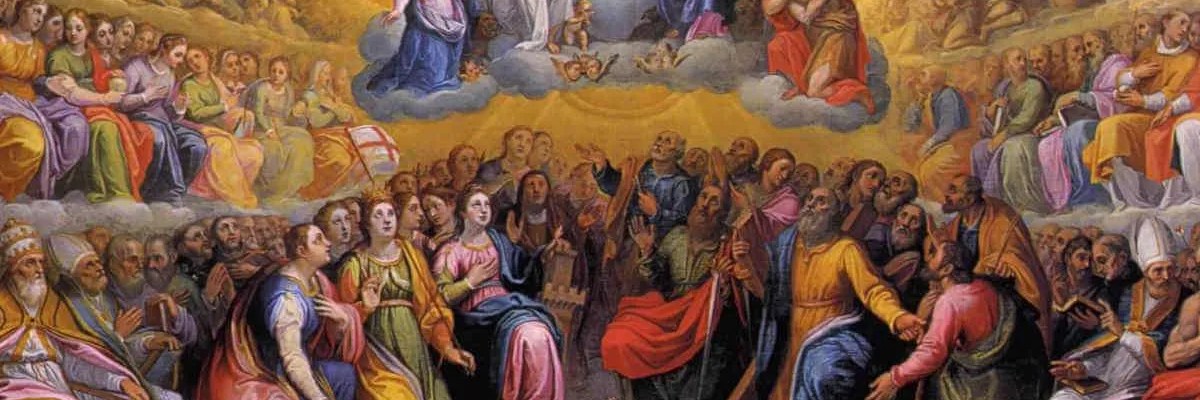
The saints are called to our attention for two important reasons. The first is the obvious one. Saints are great models, they provide a great example for us. I’ve tried to mention saints throughout the year to give us great examples and models of what it looks like to live our faith. I’ve talked about Joan of Arc, and how this uneducated, teenage girl from a small, rural farm-community followed God’s call and rescued her country from destruction. I’ve talked about Franz Jägerstätter, an Austrian farmer who lived during World War II; a husband and father, the sexton at his local parish, attended daily Mass. Franz refused to go along with Nazi Germany’s plans, and when he was drafted into the army, refused to serve, all because of his faith in Jesus Christ. He was martyred for it. Therese of Lisieux, José Sanchez Del Río, Jan Tyranowski, Isaac Jogues and Jean de Brébeuf. On and on and on. You name it, there is a person just like you, a person with a job like yours, a background like yours—saintly parents, divorced parents; ideal upbringing, not-so-ideal upbringing; young, old—there is a saint that can be not only an inspiration, but a great example of following Jesus Christ.
But also—and this is the one we often overlook—the saints also do something else. Yes! The saints are great examples for us, they give us a great model of what this all looks like. It’s like our favorite singers, we want to sing like them; or our favorite athletes, we are inspired by their talents and skills, we want to emulate them. But the saints are more than that! The saints are our friends. And I don’t mean that in some twee, sentimental sort of way. I mean that very, very concretely. The saints are our friends. And as our friends, they give us strength, they are concerned for us and for our salvation, they help us.
We think of heaven as “way up there,” up-up-and-away, far beyond the clouds, passed Jupiter, or something. When we say the saints are “in heaven,” I think a lot of us (very naturally) imagine a place filled with light, where everyone is on a cloud, everyone has a harp. But that’s not it! Heaven isn’t up-up-and-away—it’s more accurately, another dimension. There is a thin veil between our world and the heavenly world. (If you’ve ever watched Stranger Things on Netflix—great Halloween show, by the way—in Stranger Things, there is this other dimension called the “Upside Down,” which is mysteriously present as another dimension of this world.) And you know this even though you may not know it: here at the Mass, at the Eucharistic prayer, the veil between heaven and earth is torn open, and heaven becomes present to us in and through the Eucharist. The point is this: the saints aren’t just nice stories to be inspired by, they are very present and active in our lives, more so even than our own “real” friends.
One of my friends is St. Therese. Therese and I have been friends for years. Over and over again she has given me strength and comfort. She has shown a real concern for my salvation. And I’ve recognized her ever since I was very young. I was fascinated by her story. And when my mom was pregnant, I begged my parents to name her Therese if she was a girl—which they did, and made me her godfather. When I was passing through a difficult time through seminary, I prayed a novena to her, asking for a white rose to show up to let me know I was on the right track—and on day nine, right on cue, white rose showed up. At the turn of every corner, she has been there. And she’s my best friend, but not the only. Franz Jägerstätter, Benedict, Joseph—I have some good ones. And yeah, someone who is cynical, or someone who just wants to doubt everything can chalk it all up to coincidence, or sentimentality. But as our faith teaches us, it’s because the saints are very real, and very much alive—and they continue to help us along the way.
There are saints that want to be friends with you. You might have an idea of who one or two of them are; they might be trying to get your attention. So pay attention! But just like your mom taught you in kindergarten, you can also ask them to be your friend. And I haven’t had one of them turn me down yet.
Friends on the Journey
Again, I know, many of our Protestant brothers and sisters love to criticize us for our seeming “obsession” with saints—alright. But don’t let them get you down. They’re missing out!
The saints are for us such incredible models and examples, and also friends strengthening us along the way. They are the ones who have gone before us and now walk with us on this pilgrimage we call life. And they are concerned not with their own glory, becoming more famous or something—but with one thing: that like them, we would give our whole life over to Jesus Christ. Why? Because they know the secret: it’s totally worth it. In fact, it’s more than worth it. They know that no matter what we’re going through, “The only real sadness, the only real failure, the only great tragedy in life, is not to become a saint.”
 The Beggar