Solemnity of the Most Holy Trinity (B) – May 26, 2024
St. Paul – Lyons, KS
Deuteronomy 4:32-34, 39-40; Psalm 33:4-6, 9, 18-20, 22; Romans 8:14-17; Matthew 28:16-20
Monday Morning Quarterback
Do we all remember who Rohan Davey is? Rohan Davey was an NFL quarterback. Won two Super Bowls: 2004 and 2005. Rohan won two Super Bowls with the New England Patriots. Rohan was Tom Brady’s backup. Played in four games in 2004, none in 2005. Completed four passes in those four games. We’ve never heard of this guy! Why? Because we were all paying attention to Tom Brady! Here was this guy, top 1% of quarterbacks—but he spent the majority of his professional career sitting on a bench. He was on the team, part of the team, on contract, had a jersey—he was on the team! But he never did anything. And you know else stinks? He knew and understood all of the plays, and he followed all of the team rules, went to all the practices—but he essentially never played. Two years, only four passes. This guys has won more super bowls than 99% percent of all football players ever—but he never played. Keep that in mind.
Ok, today we celebrate the Solemnity of the Most Holy Trinity—God: Father, Son, and Holy Spirit; three persons, one God. This is the God we worship, the one, true and living God. The Trinity lies at the origin and core of it all, at the origin and core of our entire faith, the central Mystery of our faith (Catechism 234). But—and I don’t know about you—but I think that we easily stop there. We stop at the definition of the Trinity, we try to understand the Trinity—three persons in on God, but God is one, but there are three—we stop there.
But then, one day, I was talking to one of my good friends, and he said something that changed it all. It changed things from trying to understand the faith, to living the faith. He just looked at me and said, “Yeah, I don’t worry about that stuff too much. Because really, at the end of the day, it’s just Catechism 221. ‘God himself is an eternal exchange of love, Father, Son and Holy Spirit, and he has destined us to share in that exchange.’”
And at first I thought that was a little simple minded, but as I continued to ponder it, I began to realize how much truth was in it. God himself is an eternal exchange of love…and he has destined us to share in that exchange. And what I realized was that the Trinity is not something we are trying to solve and understand; no, it is not a problem to be solved. It is a Mystery to be lived. This is what our faith is aimed at: living the life of God, sharing in this life. And it is Jesus Christ himself that comes to bring us into that life. That is why he comes!
Ok, so here’s what I’m getting at. In our day and age, it has become very common, though, to live our faith like Rohan Davey. And what I mean is, yeah, we’re on the team, we’re Catholic, we’re Christian (as one of my favorite comedians says, “We’re ‘brand loyal’ to Jesus.’”), we have the jersey, if people ask we tell them, “Oh yeah, I’m Catholic, I believe in Jesus”—but it’s like Rohan Davey: yeah, we’re on the team…but we’re not really living it. Tom Brady is, other people are. But easily, we’re just sitting on the sidelines. And we know a lot, and we come to the “practices”—but we’re missing the game. And the big shift in our life comes when we don’t just know more, and understand more, but we really begin to live it.
The Paradigm Shift
There is a paradigm shift that has to happen—in our lives, there is a big shift that needs to happen. And this is the paradigm shift: the faith is not a club to belong to, a team to be on, a “brand” to put on, it is a mystery to live, a proposal for living life, a way of life. Long before Christians were called Christians—Christians were called “followers of the Way” (c.f., Acts 9:2). This was a Way, a method of living.
If you look through the New Testament—you want to guess how many times the word “Christian” is used in the New Testament? 3. 3 times. Jesus didn’t call people to become Christians—bear with me, you’re in the right spot, don’t worry. But Jesus didn’t call people to a brand! He called them to what? To follow him. To be his…disciple. To become a disciple: this was the call! How many times is the word “disciple” used in the New Testament? 269. 269 times. Christian, 3; Disciples, 269. Jesus wasn’t interested in a brand, he was interested in disciples. And a disciple—that’s someone who’s “in the game.” Anyone can put on a jersey, but who is going to get in the game? Who is going to play?
The paradigm shift is this: we don’t need more people to just be “brand loyal” to Jesus, or to put on “Christian” or “Catholic” jerseys, no. We need to become disciples, and we need to make disciples. That’s the mission.
Make Disciples
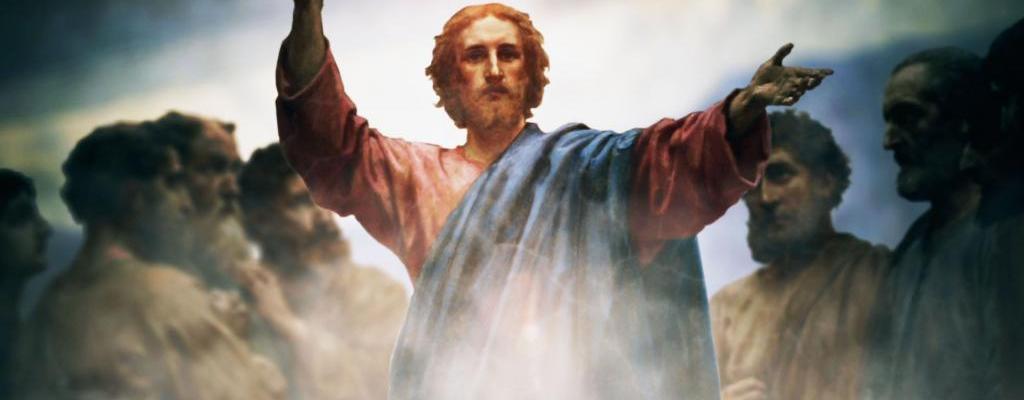
Did everyone listen to the Gospel today? (Of course you did!) Very famous Gospel. And Jesus gives his disciples their mission, their job. And this is for all of us. As “alleged” disciples of Jesus, this is our mission too!“Go, therefore, and make disciples of all nations, baptizing them in the name of the Father, and of the Son, and of the Holy Spirit, teaching them to observe all that I have commanded you.” Everyone of us should have that memorized. Homework for the week! Every one of us should be able to rattle that off, no problem. Why? Because that is the mission.
And as a parish, as a Church, as Catholics—we’re pretty good at two out of the three. As a Church, as a parish, we are very good at the “Baptize…in the name of the Father, and of the Son, and of the Holy Spirit.” In other words, we’re very good at making sure our kids get the sacraments: Baptisms, First Communions, Confirmations. We’re good at that! Praise God! We’re also pretty good (better than most) about handing on the teachings of our faith. Jesus said, “teach them to observe all that I have commanded you.” We’re pretty good at that! Even non-Christians know what Jesus teaches!
But even though we’re good at those two, we tend to be not so good at the first one: making disciples. Making disciples is the first part of the commission that Jesus gives. Because here’s the thing: you can give kids sacraments all day! But that doesn’t make them a disciple. I’ve run you through the numbers before, about how many sacraments we give and how few of those kids continue to practice their faith. But what’s going on? Being “Catholic” or “Christian” has turned into a brand, a jersey. But a disciple—a disciple is so much more!
Living the Mystery
What Jesus invites us to, and what we are meant to invite others to, isn’t a brand—it is to a life of discipleship. And to put it really simply (and we can talk more about this another day), a disciple is someone whose ultimate aim is to be with Jesus, to become like Jesus, and to live the way Jesus would live if he were in their shoes. To be with him, to become like him, and to live as he lived. And here’s the problem: we have accepted a culture in the Church, in our parish, as Christians, as Catholics—we have accepted a culture where you can be a Catholic or a Christian, but not a disciple of Jesus.
In the Gospels we always hear about two groups, right? There are the crowds, and then there are the disciples. The disciples are those who live life with Jesus, who follow him closely (not perfectly, but closely), and they strive to become like him, and they do the things he does. There are the twelve disciples, but then there are many, many others. So that’s one group. But then there is the crowd. The Gospels are intentionally written this way, as a sort of rhetorical device, to make us ask ourselves: “Which group do I fall into? Am I a face in the crowd? Or am I a disciple?”
A man that is becoming more and more influential in my life said it this way: “The greatest issue facing the world today, with all of its heartbreaking needs [and there are so many things going on], is whether those who…[identify] as Christians [as Catholics] will become disciples of Jesus Christ, steadily learning from him how to live.” The greatest issue facing the world today is not war, pandemic, elections, climate change, financial crises—as real and challenging as these are! But to get caught in those issues is to get caught in that “Option 1” mentality we talk about. No, the greatest issue: will the billions of people who call themselves Catholics and Christians, who put on the jersey, who are “brand loyal”—will they, will we become true disciples?
We can’t just put our butt in a pew and call ourselves disciples. To become a disciple will mean reordering our entire lives around following Jesus, making him the undisputed top priority, over our job, and money, and sports, and our reputation—everything. As Jesus said, “Whoever would be my disciple must deny himself, take up his cross, and follow me” (Mark 8:34). Deny—sign the title of our life over to him, quite literally give ownership of our life to him. Take up our cross—embrace the suffering and hardships this is guaranteed to brings. And follow him—“follow” is the call to become a disciple, to follow a way—the Way.
Like I mentioned, this Sunday is one of our “Reclaimed Sundays”—4th Sunday, Reclaimed Sunday. And I was talking to a family just this week; they made a big decision: they decided that they’re giving up Sunday sports. Boom: here is one practical way they have decided to live their life of discipleship. They are embracing this Way, the call of Jesus. They are reordering their life around him, making him the top priority. They’re moving from just putting on a jersey, but stepping onto the field—well, off the field—you know what I mean. They’re deciding to live it! They’re stepping out of the crowd and saying, “I want to be a disciple. I want to live it.” I mean look at that: it is possible to live differently, to follow Christ.
Be disciples. Make disciples.
But this is the decision that each one of us has to make. The great commission is to “go and make disciples.” But Jesus doesn’t send the crowd, he sends disciples. If we are going to fulfill the mission given to us, we have to first take the step: become disciples. move from just wearing the jersey to stepping onto the field. This is what we’ll be diving into more and more, especially during Ordinary Time. But this is the question: will you become his disciple? Will you reorder your entire life around following him, making him the top priority in your life?
The Trinity that we celebrate today—the Trinity is not a problem to be solved, but a mystery to be lived. Our faith—our faith is not just a series of teachings to learn, a jersey to wear; it is a mystery to be lived, a Way to follow. Over the next several months, I want to keep proposing concrete ways to live this Way. Prayer, that’s a big one. Reclaim Sunday, that’s another one. And who knows, maybe we could become a parish full of disciples, ready to embrace Jesus’ call to make disciples.
 The Beggar