12th Sunday in Ordinary Time (B) – June 23, 2024
St. Paul – Lyons, KS
Job 38:1, 8-11; Psalm 107:23-26, 28-31; 2 Corinthians 5:14-17; Mark 4:35-41
2020: The Chaos That Invades
2020 started off as a normal year. But within a few months, it became the year we won’t forget. It became an event burned into our brain. Because what the pandemic did—first and foremost, it jeopardized our health, overturned our daily routines, our economic security; it took lives, loved ones; it filled our days with uncertainty and discomfort; for a thousand different reasons, it brought chaos and fear and anger and frustration and so much more. On top of that, during the summer, there were the many events that shocked the nation and prompted social unrest and a cry for justice. And to top all of that off, as if there wasn’t enough going on—I don’t know if you remember this one—but we had an election that really brought us together! Just really brought a sense of unity… No, it drove a wedge between us. And not only between political parties, or “the country” but between families, our siblings, father and son, friends.
What these events did—these real life, concrete, tangible events—these events revealed something to us. Because what do we do? How do we think? As 21st century Americans, we think that we have pretty much everything figured out. And yeah, it’s not perfect. But we think we’re getting there! “We’re in control! We’re free! I can live my own life, and you can live your own life, and we can all get along and be perfectly happy!” But no, what the events of 2020 revealed were how we don’t have everything figured out (not even close!), and we aren’t in control (not really!). These events revealed how big and complicated and intricate and delicately balanced the entire world and society and relationships truly are. In that year, suddenly, pretty much overnight, things got very out of control, very chaotic, very, very fast. And we suffered. (I think I shared with you once about how a high schooler I knew became suicidal when the pandemic hit, just because his baseball season was cancelled.)
And in that year, collectively, everyone, without exception, began to ask one thing: “Who’s going to fix this?” And because these events were such real, concrete, tangible problems, we turned to the people we think fix the real, concrete, tangible problems in life: doctors, scientists, cops, those fighting for justice, the NFL and NBA, politicians, philanthropists. But they didn’t fix it.
Why? With all of our progress, shouldn’t we have been able to fix it? “We can put a man on the moon!” No. What 2020 did was make very real and very concrete what our Faith has tried to point out to us our whole life: we are not self-sufficient, we didn’t make the world and we aren’t in control of the world, we don’t make it go ‘round. But 2020 betrayed what we really believe! We actually believe that we are self-sufficient, that we are in control, we are in charge of the world, we do make the world go ‘round! And so 2020—what it did was it gave us an experience of what our faith tells us: we are not God. And so, in a last-ditch cry of desperation, we cried out to God. En masse we cried out to God: “Don’t you care that we are being destroyed?”
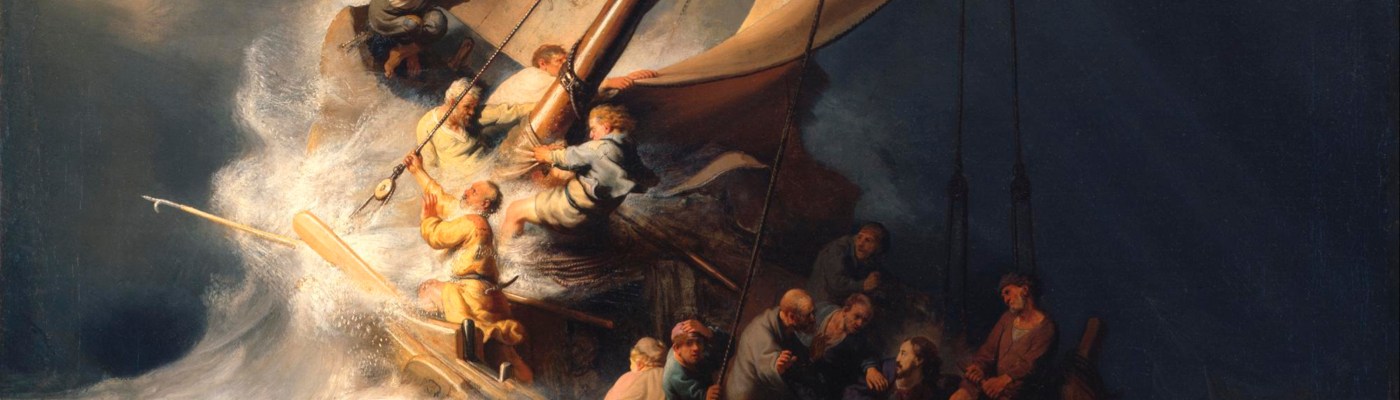
The same thing the disciples ask Jesus in the boat—as their lives are being threatened, as everything else is falling apart, they ask: “Don’t you care that we are being destroyed?” And how does Jesus respond? “I do care! Oh sorry, let me fix all of your problems. Yeah, I will ‘answer your prayers’ and bring back the NFL and make sure your candidate is elected and all of your control and self-sufficiency and financial stability is restored.” … No, Jesus responds: “Why are you terrified? Why are you scared? Do you not yet have faith? Do you not yet trust me?” Jesus’ response was: “If you believe what you say you believe: why are you so scared? why are you so uncertain? why has your life fallen apart?” Again, imagine if 2020 happened again, right now: life, job, economic security, sports, school, on and on—all of this is threatened: what is your response? how will you react? Will you react with faith and trust that God is in charge? Will you be calm and serene? OR, will you fall apart again? Will this totally ruin everything in your life? How would you react?
Jesus and Job
What our readings are getting at is this question—what Jesus is getting at is this question! In this event on the sea, the disciples betray what they truly believe. When this storm comes along—a real, tangible, concrete event comes along, threatening their lives, threatening their security and safety and control—they’re terrified! And their true beliefs are revealed: they don’t actually believe in Jesus, they don’t actually trust him. And that’s what this passage is really about.It’s not so much about Jesus miraculous power, as much as it is about instilling in us the important principle: we can trust him, we can entrust our lives to him—even when things going on around us seem to tell us the opposite.
That’s why the Church pairs this Gospel passage with our first reading from the book of Job. Job is a beautiful book. It’s a parable; not a historical account, but a story that explores a much bigger question: the question of human suffering, the suffering of the innocent. As you probably know (but I’m not going to assume), the book of Job tells the story of…Job. And who’s Job? Job is a man “blameless and upright, who feared God and avoided evil” (Job 1:1)—that’s how the whole book of Job starts. And then we hear about his perfect family, lots of kids, lots of money and land and everything. So right from the get-go, we’re told about how perfect and blessed Job is. But what happens to Job? Well, Satan goes to the Lord and says, “Look, this guy is only such a great guy because you’re blessing him with so much good stuff. Of course he’s a great guy! Anybody who is blessed like him is going to be a good guy! But if you took it all away, he would be just like everyone else.” So the Lord allows Satan to test Job. And so Satan literally destroys Job’s life: his children are killed, he loses the farm, everything is taken from him.
That’s the initial story. Most of the book, then, is a series of dialogues between Job and his friends; they’re exploring the question of human suffering, and why God allows suffering. Toward the end of the book, Job finally demands to know from God himself: what in the world?? why is this happening?? Like the disciples in the boat, who did nothing wrong but are getting torn apart by the sea, Job says, “Don’t you care that I’m being destroyed?” And that’s when God, all of a sudden, He shows up; in this big storm, He shows up! That’s where our first reading picks up today. And what does God say? “Oh Job, I’m so sorry! Yeah, I’ll fix all of these problems.” No! God takes Job on a whirlwind tour of the universe and asks him, “Did you make all of this? Do you know how it all works? Can you keep the world spinning?” I’m paraphrasing. But God shows Job just how incredibly complex and intricate and delicately balanced the entire universe is—and how He, God, is the one that makes it and sustains it.
But why? Why does God do this? Job was asking about suffering, not how the universe runs. God is responding to Job, but just to a deeper assumption Job is making, which is this: Job thinks he has enough wisdom to tell God how God ought to be running the world! (Which we have never done, right? Right, sure, of course!) So by showing him the complexity of the universe, what God is saying to Job is that Job has a very limited perspective; and what might look like divine injustice from Job’s perspective needs to be seen in an infinitely bigger perspective—which Job doesn’t have. And as the book ends, the question of what God is going to do about human suffering—it’s left unanswered. All that God really says is that we live in an amazing world, but not in one which is designed to prevent suffering. And what God asks from Job—and what he asks from each of us—is trust, trust in His character, trust that He is just and loving. God asks…for faith.
Ok, in the midst of the storm on the sea, which is also an image of all of the stuff we go through in our lives—in the midst of our challenges, does Jesus magically fix all of our problems? No. What does he do? What is Jesus’ question to the disciples? “Why are you terrified? Do you not yet have faith? Do you not yet trust me?” Jesus asks us for faith, to trust Him.
Again, some people read this passage and feel betrayed: “Yeah, but Jesus fixed the disciples’ problem, why hasn’t he fixed mine? My mom was sick, and I prayed and prayed, but she still died. I needed a job, and I prayed and prayed, but I didn’t get one.” People feel betrayed, and they quit. But look: what is Jesus trying to do? Promise to fix all of our problems? OR, asking us to place our faith in him even in the midst of our problems?
Busyness or Rest?
2020 has passed. So that’s not the problem or the crisis we’re facing. So what is it? What is one that you’re facing? What real life, concrete, tangible crisis are you facing in your life? Because no matter what it is, the temptation will always be to “take the bull by the horns” and to do it ourselves. Just about every sin we commit, it comes back to this: we think we are wiser than God, and so we tell God what he should be doing. And if He doesn’t do what we say, we ditch him, “take the bull by the horns,” and do it ourself. And yeah, maybe we keep coming to church (maybe not), but whether our butt stay in the pew or not, practically, day-to-day, we stop trusting Him, we stop placing our faith in Him, we stop thinking that His wisdom is greater. A classic example today is children, and how children have become commodities. Trouble conceiving a child? In vitro fertilization. Don’t want to have a child? Contraception or vasectomy or tubal ligation. Pregnant with a child you don’t want? Abortion. Three different things we do, all of them immoral, grave sins. And at the root of each one? We think we’re wiser than God, we feel we’re owed something, we fear we may not have it, so we take the bull by the horns—and we stay, we still go to Mass (maybe), but we abandon faith in God and His wisdom. We don’t trust Him. We become fearful about how things are going, so we stop trusting Him.
Another example that I think of often: busyness. And why? Why are we so busy? Once again: it’s fear. Back in 2020, so much was driven by fear. Nowadays, the fear is “FOMO.” (Have you heard that term before? FOMO. It’s an acronym for, “Fear Of Missing Out,” FOMO.) We fear missing anything, so we try to do everything—because maybe that will be the things that finally make me happy, maybe that will finally satisfy my restless heart. People run around, frantically trying anything and everything to feel something. And if it’s not you personally, it’s you running your kids around: “Maybe I can give my child perfect happiness if I take them to every sport, and they are in every activity, and they have every party. Maybe they will never experience difficulty or suffering! Maybe, if they just have everything, then they will be happy!” And survey says? It’s not working. Anxiety is up, happiness is down, mental health is steadily going down—and we’re drowning in busyness. And in the midst of the busy—it’s God who is always the first thing to go, AND He is also always the first one to be blamed.When crisis hits, over and over (even from people that don’t go to church, they say), “Why would God let this happen?? Don’t you care that we are being destroyed?” All of a sudden, we all turn into Job and the disciples.
And this is when God asks us the question: “Why are you terrified? Do you not yet have faith? Do you not yet trust me?”
So what’s the answer? Oddly enough, it’s “sleep.” “A violent squall came up and waves were breaking over the boat… Jesus was in the stern, asleep.” Jesus was asleep! The solution for us? It’s rest. It’s letting go of the busyness. It’s resting in the Lord, trusting him. Like I’ve mentioned (and today’s the day), reclaiming Sunday is a powerful way to do this. Because what has happened? Sunday has become just another busy day! Work, sports, travel, shopping—busy, busy, busy! And why? Because “I need these things to be happy, because I can’t really trust God. I know God says to rest today—but I can’t!” If we really, truly reclaimed Sunday, so much of the busy would have to go! If our first priority was Sunday, then we would have to say “no” to so many things in order to make Sunday happen. Are we willing to do that? I know many people that aren’t. And Sunday rest and the Sunday Mass—those are the first things to go. They still love God, yeah! But they don’t trust Him, and they think they’re wiser than Him. When push comes to shove, they trust money more, or sports more, or whatever other activity more. And we betray what was betrayed in 2020: we don’t yet have faith. Our faith is still in ourselves. We think (like Job did), “I know how all of this should work.”
Each one of us needs to begin to examine our life and ask: what is the real, concrete, tangible thing, what causes enough fear in me, that I begin to trust myself and what I can do instead of God? And what if we chose God? What if we rested in Him? What if we learned a lesson from 2020 and from all of our other experiences, and chose faith over fear? What if we began to do that by reclaiming Sunday? Maybe, just maybe, we could experience the joy, the peace, the rest that Jesus promises to those who place their faith, truly place their faith, in Him.
 The Beggar