
5th Sunday in Ordinary Time (C) – February 9, 2025
St. Paul – Lyons, KS
Isaiah 6:1-2a, 3-8; Psalm 138:1-5, 7-8; 1 Corinthians 15:1-11; Luke 5:1-11
Nolite Timere – Duc In Altum
When I was in seminary, I was confronted with this Gospel scene every morning. Every morning. In the chapel of the seminary where I went, I would get there about 6:00am to do my holy hour (spend an hour in silent prayer in front of the Blessed Sacrament), and then we would have Morning Prayer and Mass. But every morning I was confronted with this Gospel because right above the altar, in Latin, were carved two phrases from this Gospel scene: NOLITE TIMERE and DUC IN ALTUM. Nolite timere: Do not be afraid. And duc in altum: put out into the deep.
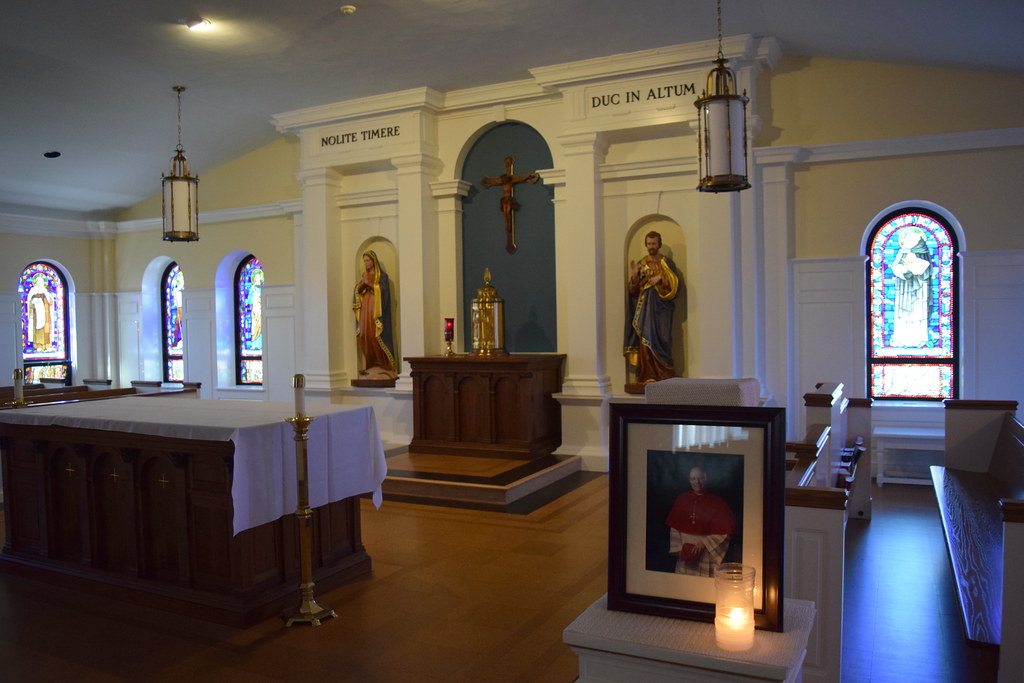
Every morning I was confronted with, challenged, encouraged by these words: Do not be afraid, put out into the deep.
I think this scene, and the readings we have today—they’re very providential today as we begin our spring series that we’re calling “Renewing…” In the first reading and the Gospel, both are scenes of people having a life-changing encounter with God. Isaiah, in our first reading, he has this powerful encounter in the Temple. Simon Peter, in the Gospel—Jesus literally just gets into his boat one day, changes his life forever. In both, it speaks to the unexpected and seemingly abrupt ways that God can just show up, break into our lives. And that’s an amazing thing! God, Jesus Christ, sometimes when we least expect it—he breaks into our lives.
But—but God never forces himself on us. Never. Sure, he shows up unexpectedly. But—but he always thenasksfor our cooperation, he asks for our free response. And only then do things change. And this is the most important decision that we can ever make! Will you—will I, will we—will you cooperate, respond to him when he shows up?
And what does Jesus ask? “Duc in altum, put out into the deep.” Jesus asks us to stop operating in the shallows, and instead to put out into the deep. In other words, Jesus always invites us from a sort of superficial, checking the boxes, going through he motions sort of faith—you know, go to Mass on Sundays (when we feel like it), maybe say a prayer before a meal, but that’s about it. He calls us from that “shallow” into the depths, into a place of radical spiritual transformation.
And both Isaiah and Simon Peter—well, they show us what the typical initial feeling is: they don’t feel they are qualified, they don’t feel like they’re the right candidate for that kind of thing; all of a sudden, they have a more intense awareness of their sinfulness and their brokenness and woundedness. And they are afraid! But what does Jesus say? Nolite timere—do not be afraid! Duc in altum—put out into the deep!
The Experience of Healing
So here’s the thing: I think that the experience Isaiah and Peter had is not so different from the experience we have—that you and I have. Like Isaiah, like Simon Peter, we believe in God, we do the “church thing,” we say some prayers. But when the invitation comes, “Duc in altum, to go deeper”—well, we begin to shy away from that. Why? Because it’s scary, it seems like a big leap, sure. But also, we know that we aren’t perfect and we have a lot of baggage. We’ve been doing this for years, been coming to Mass—and nothing seems to have changed for us. Or like I said a few weeks ago, we see other people going to Mass (for decades, their whole life!) and they’re still miserable, mean, greedy, rude, jerks. And so we don’t really believe there is anything special, anything radically transformative that can happen with Jesus.
And then you start to hear me talk about how we’re going to focus on healing, and “experiencing the healing power of Jesus Christ in our lives”—and it’s easily to think, “Yeah, sure. I’ll just let Fr. Michael do his thing. I’m sure there will be a good story or two along the way. But I doubt anything ‘powerful’ is going to happen. Doubt anyone’s getting ‘healed.’ Definitely not me.”
And that’s why I want to address—real quick—what I mean. Because I’m not talking about, like, healing cancer, or scoliosis, or something like that—although God does still do miraculous physical healings! (And we’ll talk about that down the road.) But what I’m talking about a much deeper healing, a healing of your heart, of your soul—you, healing you, your whole person. So that’s first: this healing is not about primarily about something physical. We’re talking about a deeper healing, a healing of the heart and soul, the healing of you, your person.
So what do I mean by “healing”? I think it is very easy for us to equate “healing” with being “fixed.” If God “heals” me, that means that I am “fixed,” I don’t suffer, the past and what happened in the past is magically gone, I feel “happy”—everything is “fixed.” So first and foremost: healing, the healing that God brings isn’t “fixing” us. Rather, this is what I think God’s healing means: to be healed means to be set free to love the way you have been created and called to love and to receive love as we were created and called to be loved. To be healed (like we’re talking about) means to be set free to love the way you have been created and called to love (in other words, to be able to embrace our cross, to be able to suffer well, to allow even our wounds and brokenness to be instruments of love)—to be set free to love the way you have been created and called to love and to receive love as we were created and called to be loved. Jesus doesn’t promise to “fix” us, but to “heal” us. And as a sign of this—just think of Jesus, risen from the dead, those scenes in the Gospel where people see him—what does he still have? The risen Jesus still has the wounds from his crucifixion. “By his wounds we are healed.” So this healing isn’t just fixing, no. It’s a transformation in which we are freed to love in the way we were created and called to love—wounds and all.
St. Mark Ji Tianxiang
And here’s an example. I want to share a quick story about a man from China. Not that one, a new man from China! This man from China is a man by the name of Mark Ji Tianxiang, and Mark is now a canonized saint of the Church: St. Mark Ji Tianxiang.
Mark grew up in a strong Catholic family in 19th century China. By 35, he was a well respected leader in his community. He was a doctor who treated the poor for free. He was also a family man with two sons—and he ended up having six grandchildren. One day though, at 35 years old, Mark contracted a stomach virus while treating a poor person. And as a doctor he decided to treat himself with a common medicine at the time: opium—which is essentially a pure form of heroin.
But while using this drug, Mark became addicted. And as a good Catholic, wanting to fight this addiction and not give in and allow it to destroy his life, Mark kept going to confession, repeating the same sin over and over again to this priest. Unfortunately, the priest (like many people then and now) did not understand addiction, how addiction inhibit one’s freedom (freedom being a necessary element for committing a mortal sin). And so since Mark kept confessing the same sin, the priest thought, “This guy isn’t sorry.” And so after a couple of year of this, the priests got fed up and said, “Okay, Mark, only come back to confession when you’re actually sorry, when you’re done with drugs.” So the priest did not absolve him and told him not to receive the Eucharist.
And Mark, as a devout Catholic—he was devastated by this. He loved going to daily mass, he loved to receive the Eucharist. And on top of this, news began to spread among the Catholics in his area, and in his parish.
But Mark knew that even if he couldn’t stay sober, even if his priest had told him not to receive the Eucharist—God still wanted him to keep showing up to Mass, God still wanted him to follow him, to be his disciples. So for 30 years—30 years of addiction—Mark continued to show up to Mass, continued to serve the poor, continued to love. For 30 years he would come to Mass, ask for a blessing at communion, and then beg God for the grace to persevere in love.
In 1900, the Boxer Rebellion broke out. The Boxer Rebels were of violent and radical Chinese nationalist group, and they began hunting down and destroying any foreign elements in China—most notably, European missionaries and Chinese Catholics. One day the Boxer Rebels knocked on Mark’s door and arrested him and his two sons, one of their wives, and his six grandchildren. And they were all brought to prison. And imagine: Mark is with his family and with all the other Catholics in the area who have been arrested. And all of them looking at Mark—Mark, who’s been addicted to opium for 30 years, his body is emaciated (almost skeletal looking, like heroin addicts today), and they think, “This guy…as soon as he’s given a chance to apostasize, to reject the Catholic faith, he’s going to be the first one to leave! He’s probably going to take any chance to get back to his opium pipe.” That’s what they thought.
And Mark was given his chance to apostasize, to reject his Catholic faith. But when given the chance, Mark said, “Heaven is open. We would rather die than betray God!” And as Mark and his nine family members were dragged from prison to be executed, one of his grandsons said to him, “Grandpa, where are we going?” And Mark said, “We’re going home. We’re going home.” Mark then begged the executioners to kill him last so that none of his family members would die alone. He stood beside all nine of them as they were executed. And then Mark went to his death praising God, singing the Litany of the Blessed Virgin Mary.
Duc In Altum
Mark went to his death an opium addict. Not a former addict, an addict. Mark wasn’t “fixed,” but he had definitely experienced God’s healing power in his life. Mark knew that his life, his salvation was not, could not be based on him showing up to God and saying, “Look at me! I’m perfect. No sins. No problems. Totally fixed.” No. Mark could only rely on God. Like Isaiah, Mark would say, “Woe is me, I am doomed! For I am a man of unclean lips, living among a people of unclean lips.” Like Simon Peter, Mark would say, “Depart from me, Lord, for I am a sinful man.” But also like Isaiah and Peter, Mark was not afraid to go into the depths.
So don’t hear what I’m not saying. My point is not, “Hey, don’t worry about your sins. Don’t worry about drugs and murder and adultery. We’re all good. Everyone goes to heaven.” No! Not at all. Again, Mark wasn’t callous about his addiction or think it was ok. My point is that in the midst of his brokenness and woundedness, and dare I say through his brokenness and woundedness, in the midst of that suffering, Mark experienced a healing from Jesus Christ that allowed him to love the way that he had been created and called to love. Mark loved in the midst of his suffering; he loved his family, his community, God. In the ultimate act of love, he went to his death, martyred for his faith. To this day, Mark is a source of inspiration and hope for addicts—he’s the patron saint of addicts. He is a canonized saint.
It makes me think of our patron, St. Paul. St. Paul, in his second letter to the Corinthians, talks about a thorn in his flesh, something he prayed God would “fix,” that God would take away. But God never did. So was the great saint and apostle Paul not healed, did he never experience Jesus’ healing? I don’t think we want to say that. Because what did Jesus tell Paul? “My grace is sufficient for you, for my power is made perfect in weakness” (2 Cor 12:9). Paul wasn’t “unhealed,” he just wasn’t “fixed.” Paul—brokenness, weakness and all—loved the way that he had been created and called to love.
Or Simon Peter—when Peter said, “Depart from me, Lord, for I am a sinful man,” did Jesus magically “fix” him on the spot? Nope. Peter still had a lot of problems, still did a lot of dumb things. But over time, little by little, did Jesus change him, transform him, heal him so that he could love the way that he had been created and called to love? Yes.
My point is this: Jesus can do the same for each one of us. Our healing may look very different than we expect, I can almost guarantee it won’t look like us being “fixed.” But we can be transformed, radically changed. So nolite timere, do not be afraid, duc in altum, put out into the deep. Do not be afraid to go into a deeper spiritual place, into a place of real, radical spiritual transformation. And each and every week, pray those words intently before Communion, “Lord, I am not worthy that you should enter under my roof. But only say the word and my soul shall be healed.”
 The Beggar