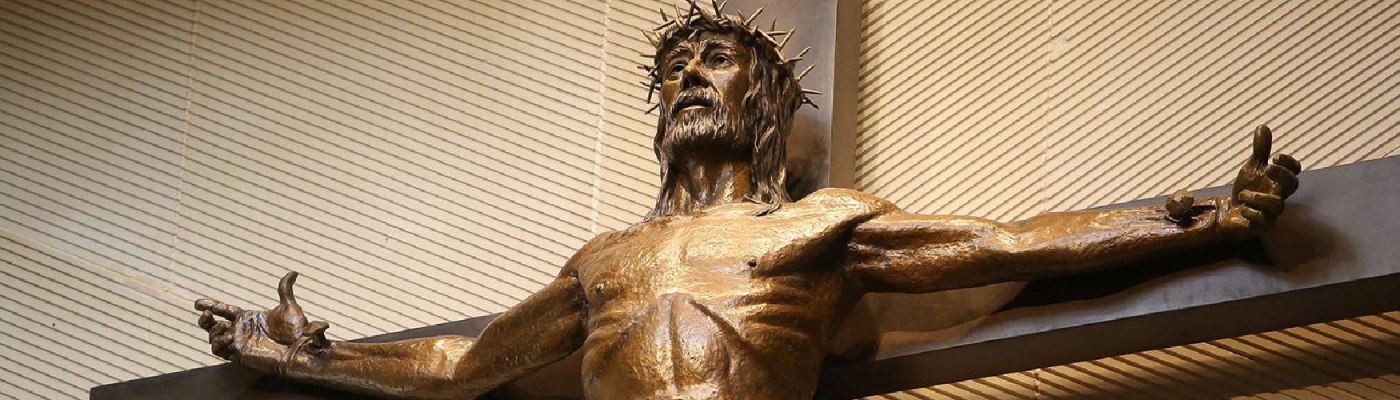
Feast of the Exaltation of the Holy Cross – September 14, 2025
St. Joseph – Wichita, KS
Numbers 21:4b-9; Psalm 78:1b-2, 34-38; Philippians 2:6-11; John 3:13-17
Why this feast? What is the Cross?
Today is one of those strange ways the Church calendar works, the ranking of feasts. Today, since September 14 falls on a Sunday—today we celebrate the Feast of the Exaltation of the Holy Cross, the Cross of Jesus Christ. The quick history is that the year 326, St. Helena, the mother of the Roman Emperor Constantine—Helena found the true Cross, the Cross on which Jesus was crucified. And on September 14, 335, Constantine dedicated the Church of the Holy Sepulcher in Jerusalem, the Church constructed over the site of Jesus’ crucifixion. And so practically speaking, that is where this feast comes from: from the discovery of the true Cross, and the dedication of the Church of the Holy Sepulcher.
There is also another day on which we “exalt” the Cross. When? A day on which we adore the Cross. When? Exactly, on Good Friday! On Good Friday—there is a part of the liturgy during which we adore the Cross. The priest carries the Cross and sings, “Behold the wood of the Cross, on which hung the salvation of the world.” And you respond, “Come, let us adore.” And then we come forward and kiss the Cross in adoration.
But this is what I want us to notice. We all walk in here each Sunday and see the Cross—and we don’t blink. We get jewelry of the cross, statues of the cross, crosses for our house, cross tattoos—and we think this is normal! And all of this shows our devotion. We “exalt” the cross without realizing it. But notice! What is this thing? Forget about Jesus for a second. If you lived in the year 30, in the middle of the Roman Empire, before Jesus was crucified—if someone from the year 30 time traveled here and saw that hanging on the wall—what would their reaction be? They would be absolutely and utterly confused, disgusted. They would think that we had lost our minds. Why? Because for them, before Jesus, this was the most violent and terrifying form of capital punishment, of execution. It would be like us walking into a church with a guy strapped in an electric chair on the wall, or people wearing electric chair necklaces, electric chair tattoos. We would look at them like, “What is wrong with you??”
The cross—the cross is not a religious symbol, not originally. The cross—the cross was the most brutal, vile, and evil death imaginable. Throughout the Roman Empire, the cross was the most cruel and terrifying punishment, the most pitiable, the most shameful form of death. The cross was a sign that you lost! Rome would crucify its enemies not only to kill them, but to degrade and humiliate them. If Rome conquered your town, they would crucify the leaders of the town along the major highways to tell people, “We won. You lost. And if you try anything, we’ll do that to you as well.”
And in Jesus’ case, the Cross is even worse because of all the other details surrounding it! The leaders of the people (the chief priests and the scribes and the pharisees)—the people that should have been on Jesus’ side—they plot his death. In his hour of need, his own friends fall asleep, abandoned him, betray him. The leader Jesus chose denies him. His own people cry out for his death. He is mocked, beaten, scourged, crucified. He dies. Over and over, the Gospels share the story of how the cross isn’t just a painful death. The Cross of Jesus—the Cross was every kind of evil imaginable, all wrapped into one. On the Cross, all the powers of evil and darkness converge. And they converge on Jesus.
So yes! Historically, this is what the cross is. It is all of those things. So why did Jesus embrace the Cross? Why would he go through that? Why fix things through the Cross? We give pious answers: “He died on the Cross to save us from sin, to show us how much he loved us,” or, “On the Cross he bore our punishment, he paid the price for our salvation.” And sure, there are elements of truth to each of these. Sure! But he’s God! Why doesn’t he just snap his fingers? Why die on the Cross? Why did Jesus have to die at all?
The Path of Trust
Well, think back to the original problem, all the way back in the Garden of Eden, Adam and Eve, their sin. Genesis 3 gives us a story not of how two naked people in a garden ate an apple. Genesis 3, in a mythic and poetic way, tells a true story about how humanity was led into open rebellion against God. Why? Because humans are free—we’re not robots—so we can freely choose to follow the plans God has for us…OR not.
And in that scene, in that scene which gives us the “origin story” for why everything is so messed up in the world and with us—the answer is that humanity listens to the Enemy instead of God; they listen to his lies; they trust his words over God’s words. And the Enemy, the ancient Serpent, Evil One—the Evil One doesn’t try to convince them to murder someone or something. The Enemy plants a simple deception in their mind—simple! He places God, he casts the good Father in suspicion. He accuses God. He deceives us.
And the deception sounds something like this: “God is not a father, at least not a good father. He doesn’t really love you. You can’t trust him. He’s holding out on you. He’s restraining your freedom! If you just had this or that you would be happy, and he won’t let you have that.” And then the Evil One gives us the solution, “Just rebel.” Just rebel! “You do you.”
This is the problem. Yeah: war, disease, discrimination, inequality, suffering, death, on and on. These are all problems. But the problem, the problem at the root of it all—we subtly and not-so-subtly reject the idea that God can be trusted, that he is good. The problem isn’t “out there.” It’s right here *points to heart*. Think about it: how many times have we fallen for that lie?
Ok: this is why God can’t just snap his fingers and fix this! Because the issue isn’t “out there.” It’s right here. I do not trust that God is a good Father—not totally! And because this is a problem with me, within me—God would have to destroy part of our heart to get rid of this. And this is the conundrum.
So why does Jesus embrace the cross? Because he needs to show us that—contrary to every deception—THAT THE FATHER CAN BE TRUSTED! And trusted even in the face of the most terrible situation imaginable—the cross. On the Cross, Jesus is showing us—contrary to what the Enemy says—Jesus is showing us that the Father can be trusted, even to the point of death.
The Cross In Our Lives
Now, this is all beautiful and important. But—but the important question for us today, then, is not just why do we exalt Jesus’ Cross, but why do we exalt the cross, the crosses in our daily lives? Jesus told us this, “If anyone would come after me, let him deny himself and take up his cross and follow me.” We have our crosses too!
I’ve always loved St. John Henry Newman’s description of the cross in our lives. St. John Henry Newman—soon to be declared a doctor of the Church, so his opinions are pretty important—Newman said, “The cross is the place of unfulfilled desire.” The cross is the place where things didn’t quite go as I planned, as I wanted, as I hoped. The cross is the place of suffering, of betrayal, of anger and resentment. The cross is that memory that I can’t get rid of. The cross is that thing I did as a junior in high school and wish I could take back. The cross is the place of isolation, and loneliness, and abandonment. The cross is that one place in my life that if I could wave a magic wand and make it all go away—I would. The cross is the place of unfulfilled desire.
The great lie of our time is that happiness and fulfillment will come from following my own dreams, taking life by the horns, making something of it, fulfilling our desires! We go look for comfort, security, help, solutions, whatever—we go trust something or someone else: scrolling on TikTok, the news, YouTube, food, alcohol, dances, telenovelas, a new truck or a new spouse. When our desires are unfulfilled, our tendency is to say, “Well, God must not be in charge, He must have gotten something wrong. He must not be good.” And we rebel, just like Adam and Eve.
And we know where that road leads, not only for Adam and Eve, but for us! We know what happens when we follow our own plans, leave God behind, try to make everything happen for ourselves. We are left emptier than we were before. I hope you’ve taken time to reflect and realize this: a life apart from God doesn’t fulfill us, it only leaves us in those places of the unfulfilled desire.
But that’s not the story of the Cross. On the Cross, we see what happens to those places of unfulfilled desire: in a mysterious way, death, the death we feel from this is not the end. The cross, those places of unfulfilled desire—they’re no longer the end. They don’t have to be. As Jesus shows us, the suffering of the Cross leads to the glory of the resurrection.
As we meditate on the Cross today, then, this is what we have to return to. And today, in and through this Eucharist where Jesus’s sacrifice on the Cross is made present once again—today we unite ourselves with Jesus on the Cross. Why? Because there, beginning from there, everything will change. Everything. Our deepest and truest desires will be fulfilled.
 The Beggar