Feast of the Transfiguration of the Lord (A) – August 6, 2023
St. Paul – Lyons, KS
Daniel 7:9-10, 13-14; Psalm 97:1-2, 5-6, 9; 2 Peter 1:16-19; Matthew 17:1-9
From Apostolic Times to American Times
Today we’re celebrating the feast of the Transfiguration. It was probably a seemingly normal day for Jesus and the Apostles, Peter, James, and John. But then there was something a little shocking. And even though it was in the plan of the Father—this shocking event began a tough journey, one that required courage and boldness, one that involved crucifixion—but one that resulted in a newness, life, salvation. So this feast, and the progression of this feast, are very similar to my homily today. Normal day, but there might be something a little shocking. And even though I’m convinced that this is indeed the plan of the Father for the parish, it will involve a journey, one that requires courage and boldness. But it’s a journey that I’m convinced will bring newness, life. Maybe we can skip the part where you crucify me, ok?
So the Transfiguration. In the broader, bigger picture of Jesus’ life, the Transfiguration is a turning point, it’s a “hinge” that the story turns on. Jesus takes Peter, James, and John up the mountain and there is this great manifestation of what’s really going on. Jesus isn’t just a nice guy with nice teachings. There’s so much more! This guy that most people think is just Joseph’s kid from Nazareth…not the whole story. But, again, in the broader, bigger picture of Jesus’ life, the Transfiguration is a turning point. And this is the turn: from this point on, Jesus is making his journey toward Jerusalem, toward his crucifixion.
This shocking event is the first domino for all the others—those events at the core of our faith. Jesus dies, but he is risen. The disciples meet this risen one. Their lives are changed. There is a new life poured into their hearts. The world is changed. A promise of a new and renewed humanity is awakened. Life can be different. Life is different. And all of this is so real, so intense, so all-encompassing that the disciples, the Apostles go out into the world and are ready to die for this. And die they did: 11 of the 12 Apostles were martyred. This event leads to that.
But something has changed. By the time the faith reached us, today, now, here in the United States, in 2023—something is different. The Apostles went out proclaiming that Jesus is raised from the dead, that life is different, that your life can be different, that there is a life and joy and peace and happiness and love beyond all telling that we can experience even now! But now—something is different now, apparently. How many of us are ready to die for our faith today? Is the fact that Jesus rose from the dead—did that get you out of bed today? Are you willing to die for that? Or think: Why are most of our parishioners not here? Why is this thing that many people died for—why is it now something less important than sports or the grocery store?
A Common Tale, But It Doesn’t Have To Be
Back during “Rerouting…,” I shared the story of this man from China. Quick recap if you weren’t: there in China, where it was illegal to have Mass, Catholics gathered secretly in homes, and a priest would travel around to say Mass. So this man was one of them, and was captured by the Chinese soldiers and tortured; they wanted him to give up this priest. But no amount of torture, or beatings, or cattle prods could change him. He was ready to die for his faith, ready to be a martyr like the Apostles. So they let him go! Later on, when he and his family escaped to America, they were overjoyed because here they could attend Mass every day, freely live their faith! But—little by little, this man started investing more of his time, and energy, and attention to his work. No more daily Mass, started missing Mass on Sundays, started attending Mass only on Christmas and Easter—to the point that now, he doesn’t even go to Mass at all. Here is a man who went from “ready to die for his faith” to “not even going to Mass.” And the point was this: What Communist China couldn’t do, what torture couldn’t do, what cattle prods couldn’t do…our culture was able to do—and it didn’t even have to try.
The reason I shared that story then and am sharing it again now is because we have to recognize that that story isn’t a freak-occurrence. It’s something we know, personally. Many of us can remember how our grandparents and great-grandparents—they were all Catholic, or they were all church-goers in some Christian denomination. And our parents and aunts and uncles were all baptized and married in the Church—but many of them don’t practice any more (we know many like that, yeah?) And their kids (my age) were all baptized, First Communion, Confirmation, went to church growing up—but more and more they are not getting married in the Church, and they don’t practice their faith anymore. And their children (so the kids we see around today), they get baptized sometimes (because grandma wants it)—but they don’t live the faith in any real way, they don’t live it at home with their parents. And the next generation…?
I’ve shared that with you the harsh reality here. Of the baptized Catholics in town, only about 25% attend Sunday Mass on a regular basis. 17 kids made their First Communion back in May—3 currently attend Sunday Mass. 32 kids were Confirmed this Spring—4 currently attend Sunday Mass. About 110 kids participated in PSR or youth group on Wednesday evenings last year—only about 20 attend Sunday Mass. The story of the man from China isn’t a random, freak-occurrence. It’s very real. Very concrete. Here.
“Insanity is doing the same thing over and over and expecting different results,” right? But we like to do what is comfortable, to stay where it’s comfortable—and hope for different results. At the Transfiguration, Peter wanted to make some tents, just stay there—it was comfortable. But Jesus had a journey to make, a mission to accomplish, and it was going to take courage and boldness, not comfortable and doing the same thing. The Apostles too—they were going to need to live a life of courage and boldness, not just do the same thing, hoping things would change.
Bishop Kemme has been saying for years that this time, our time is one like the Apostles. And what he means by that is that the times we’re living in are like those earliest days of the Church. We are living in a world and in a culture that may not seem like it, because we’re not getting killed on the streets like they were back in the earlier days—but we’re living in a world and in a culture that is hostile to the faith, more hostile than Communist China! Even here, in small-town America, the culture is one that actively attacks the faith, your faith, the faith of your children—just not in ways you might classify as “attacks.” And Bishop Kemme isn’t saying we should complain about it, he’s saying we need to adopt the stance of the Apostles. So what does that mean? 1) It means that we need to be willing to live our faith in courageous and bold ways—just like the Apostles and earliest Christians. 2) It means that we need to gather in small communities to live this communion more intensely—not just show up to a building haphazardly once a week. 3) It means that we need to center our lives on Christ, specifically his presence in the Eucharist—not just fit him into our schedule when we can. Our age is one like the Apostles: and living a life like theirs…it will change the world!
Think about it: Peter, James and John, the twelve, they left their homes and followed him. And they spoke of this man to their friends. They told other friends, and these in turn told other friends, and others again. This is how the first century passed. And these small communities invaded the second century with their faith, at the same time invading the geographic world. They reached Spain and even all the way to India during the second century—so less than two hundred years. Then those of the second century told others who lived after them, and these told others after them. Like a great flow that grew wider and wider, like a river that grew fuller and fuller, like a mustard seed it grew bigger and bigger…and they ended up telling my mother—my mother! And my mother told me when I was young.
Vita Familia
My mom—my dad…their number one goal for us was never to have the smartest kids, or the most athletic kids, or the popular kids, on and on—none of that! Their number one question: is this going to bring my child closer to Christ, lead them to heaven, fulfill God’s will for them? Their number one priority for us? Christ. And this was reflected in our daily, weekly, monthly, and annual calendar: it all centered on Christ, on the Eucharist, Mass every Sunday and every day, daily prayer, celebrating the great feasts of the church’s year as our biggest celebrations and not the 4th of July or Halloween. They centered our life on Christ. How? In practical ways: the Sunday Mass (and daily Mass)—so the Eucharist; our family life (so their marriage, but also family prayer, family meals); and our community (living the faith with others). Simple: the Eucharist, the family, the community. Simple, but 10 out of 10 of us still practice the faith…so maybe they’re not as crazy as we thought they were.
Pope Saint John Paul II—he said that the Church would be renewed not by an amazing pope, or bishop, or new policies, or changing certain disciplines, or being more “this” or less “that,” no. John Paul II said, very prophetically, “The Church will be renewed through the family.” And not just two people that have kids—a family that derives their life from the Eucharist, from Christ himself, and lives that intensely in their family life.
And here at the parish, that is the same conclusion we keep coming back to. If we want to renew the life of the parish, of the Church—if we want to experience the life, the newness that Jesus is offering, that is revealed in the Transfiguration—it has to begin with the family, in an intense way in the family. I don’t practice the faith, my siblings don’t practice the faith, I’m not a priest, my sister isn’t a nun because we went to PSR on Wednesday evenings—in fact, we never did, not once. Things were different because we lived our lives centered on the Eucharist, we lived the faith intensely as a family, and among a community of families living the faith as well.
St. Paul’s Vision for Transformation
This is where the “shocking” part of the homily comes in. Here at St. Paul, we know that the culture around us is hostile to the faith. We know that even though people come for Sacraments or on a Wednesday evenings for PSR, this isn’t cutting it. We know we’re living in Apostolic times. We’re not insane—you’re not insane, I’m not insane. And so we know there needs to be a change.
One of the biggest changes that we’re making is that we’re no longer going to have the normal Wednesday evening PSR. And the reason for that is everything I’ve just listed off, but also it doesn’t work. It’s not helpful. And even worse: it’s an empty promise. It’s offering a false promise to parents. It’s saying, “If you bring your kid to this, they are going to grow up to live the faith.” And that’s not true. At all. There are always exceptions to the rule, yes! There is always that one kid, I know! But you don’t operate according to the exception. The “rule” of PSR is: it’s not helpful, it’s not working.
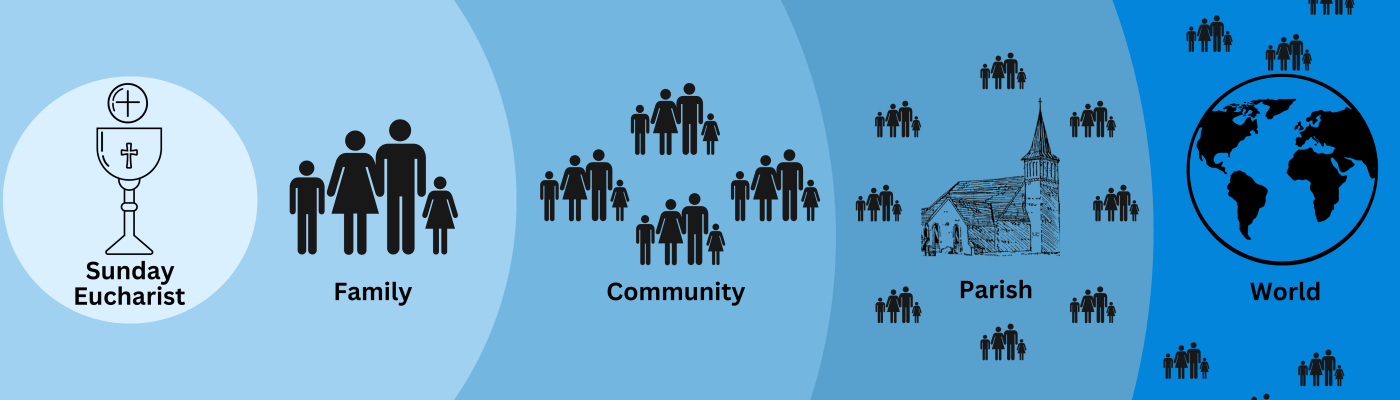
But more than that, we’re making this change because there’s a better way. It’s a way centered on the Eucharist, specifically the Sunday Eucharist, Sunday Mass. It’s one that is focused on caring for and supporting marriages and families. And from the family, into a small community of families. And from there, into a larger community of families—that’s what we call a parish. And from there into the city, and the world. It’s the Eucharist that transforms us, that builds us—everything flows from there, and it flows through the family.
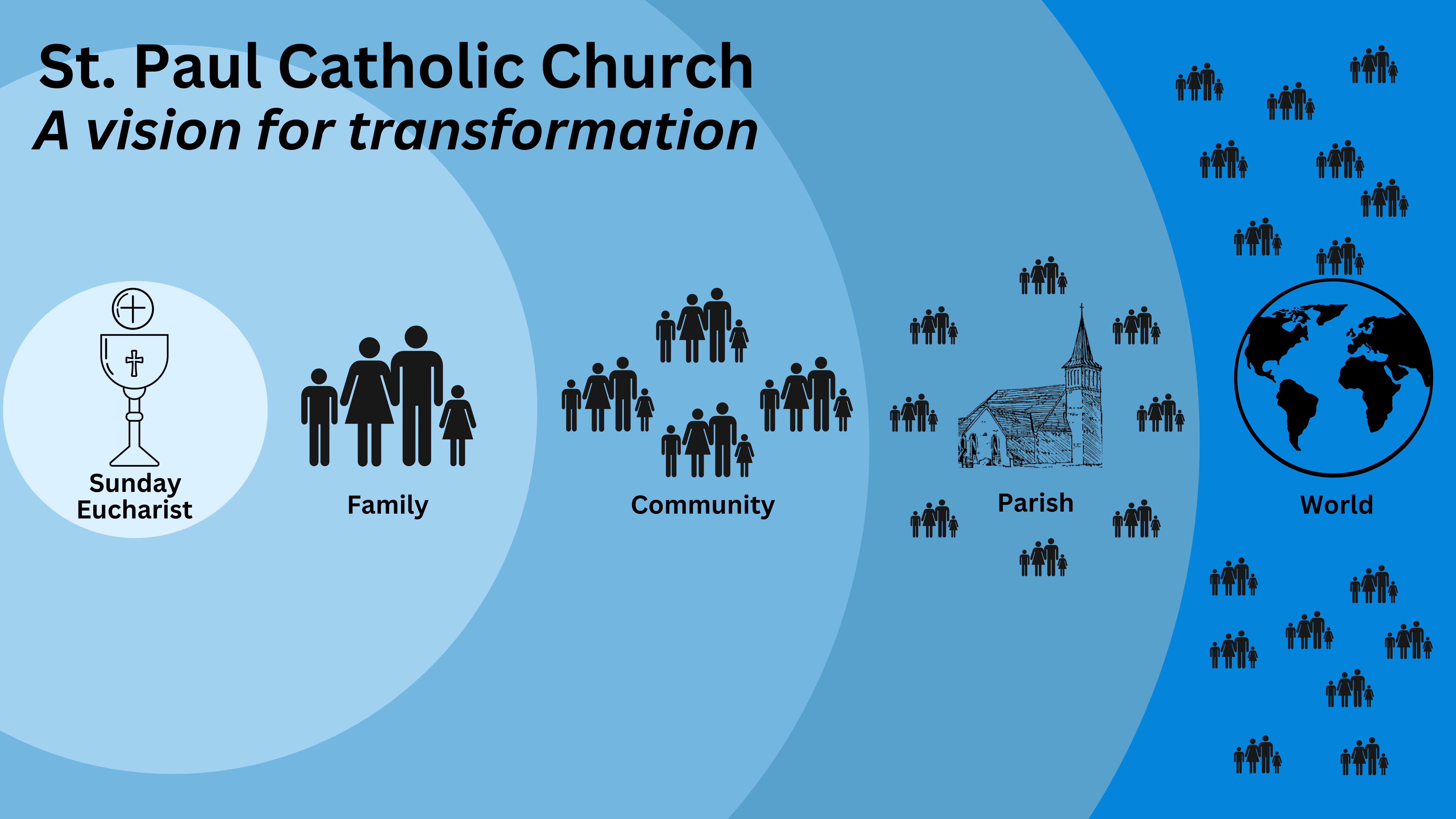
Practically, concretely, what this is going to look like is a few different things, all very intentional and carefully chosen. One of them is an initiative we call “Families of St. John Paul II.” This is essentially the “Cliff Notes” version of my life growing up. Families of St. John Paul II proposes a method of daily prayer for the family, communication for spouses, a group of families to gather with once a month and to share life with, retreat days, annual vacation. Really, it’s a way to live the communion Jesus envisioned in a real and practical way.
We’ll have something called Catechesis of the Good Shepherd, which is for 3-6 year olds. We’ll have preparation for First Communion and Confirmation, and we’ll do that on Sunday mornings between the Masses, and parents will participate with their child. As they get older, kids need to learn to live their faith among their peers, so we’ll have youth group opportunities for older kids on Wednesday evenings. Opportunities for men and women to grow individually, like Walking with Purpose, retreats like “the RESCUE,” or small groups like, “Rerouting…” So there are many, many ways for people to be involved.Yes, the loss of PSR can seem like a defeat. But it’s not. I promise you it’s not. We’re making a proposal. And the proposal is that the Eucharist and the family life be given priority. If parents want to bring 110 kids to something for one hour a week, the best thing they can bring them to is the Sunday Eucharist—and that as a family. Because that’s where the renewal of our parish, of our town, of our world will flow from.

A Transformed Life
I don’t know if you realize this, but Monday is the 35th anniversary of the dedication of the church. 35 years ago, our community built and dedicated this church. In about four years, in 2027 we’ll celebrate our centennial, 100 years here in Lyons. And as we reach these milestones, we’re looking at them with Apostolic eyes, with courage and boldness—with an absolute confidence and trust, a complete surrender to the Lord…because He is at work.
Yes, it’s going to take some changes. Changes to PSR, new initiatives being offered. But it’s going to take some other practical changes: changes to Mass times to make them more accessible to more people, or to accommodate other changes. Heads up: starting on September 10 (so the weekend after Labor Day weekend) Mass will be at 10:00am, not 10:30—then parents can attend Mass with their children and go to Sacramental preparation between Masses. During the week we’ll have Mass on Tuesdays and Thursdays at 7:00am (so more people can go before work, kids can go before school if they would like), and Mass on Wednesdays at 6:00pm (so high school kids can go before youth group, or adults can go after work).
With these changes, all of this is going to take everyone playing a part. Some people will be asked to step up as leaders. Catechesis of the Good Shepherd needs some dedicated people to be trained. People to provide child-care for parents. Volunteers to bring food for youth group, or volunteer during youth group. Prayer warriors for families, for people that have fallen away. On and on! It’s all-hands-on-deck! Business as usual…it’s not working. Now is the time for boldness and courage. Now is the time to look to the Apostles.
So…do you want to crucify me yet? This is an exciting time in the life of the parish. Never been a more exciting time than now. And as we move toward our centennial, it will only get better and better. The Lord has so much prepared for us.
But it begins here…and it always returns here. Here, at this Eucharist. This church we built 35 years about was built for this—literally. And from here, everything will flow. From here, our lives will be transformed. From here, new life will flow.
 The Beggar