19th Sunday in Ordinary Time (A) – August 13, 2023
St. Paul – Lyons, KS
1 Kings 19:9a, 11-13a; Psalm 85; Romans 9:1-5; Matthew 14:22-33
The Crux of the Matter
Today the Church begins placing a new theme in front of us, a theme for us to pay attention to for the next several weeks. Remember where we’ve been. Jesus has arrived on the scene—we call that…Christmas! He’s grown up in Nazareth—so everyone assumes he’s some normal kid. But then he begins doing things—goes around teaching and healing. He sends out the disciples to announce everything that’s going on—brings others to share in his mission. He announces that this kingdom is found not in a political structure, but in a relationship with him. In his transfiguration he reveals the glory hidden within him. But now—now the question is: Can we trust this man? Can we entrust our lives to this man? Do we trust him, and entrust our lives to him?
Right? Again, we all just kind of take this for granted. We come to church, we “believe in Jesus” (whatever that means), and we go along with it. But if you listen to people—listen to people today, listen to people in the Gospels—what you hear time and time again is, “Jesus? Wasn’t he just a rabbi from Nazareth? Wasn’t he just a nice teacher? Sure, we should take some of his advice, but I’m not going to follow him or give-up my life for him.” We hear this in the Gospel itself: Jesus is back home in Nazareth, teaching about and announcing the Kingdom, and people aren’t buying it; they say, “Isn’t this the carpenter’s son? Isn’t this Joseph and Mary’s boy? Didn’t we watch this kid grow up?” (c.f., Mt 13:55).
This is the crux of the matter! Because Jesus doesn’t ask us to believe certain facts about him, or to follow some better rules so that we’re “better people.” Jesus asks something very bold, very demanding: He asks us to literally, literally place our life into his hands.
And this is what the Church has us focus and meditate on for today and the next three Sundays, this is the question the Gospel of Matthew tries to address in these chapters: “Can we, do we trust this man? Do we have faith in this man?” It’s the question of faith.
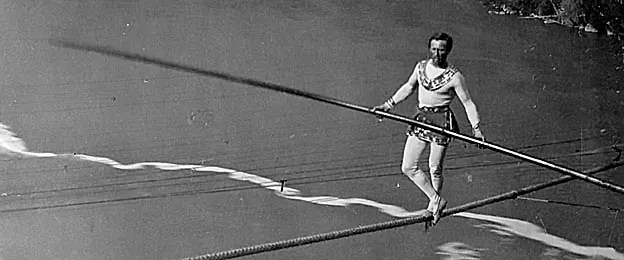
The Great Blondin
There is this very famous guy by the name of Charles Blondin, lived back in the mid 1800’s. Chuck (as we’ll call him)—Chuck was a very famous French acrobat, a tightrope walked. Very famously, he’s the one that would walk a tightrope stretched over Niagara Falls—almost a quarter of a mile. Thousands gathered to watch. And it was so easy, he’d find ways to make it more difficult. He cross the rope on stilts, on a bicycle—easy! One day, what he started doing, is he took a wheelbarrow full of rocks, and he started wheeling this wheelbarrow full of rocks with him. And he’d go back and forth. And the crowds there were cheering him on, going crazy! After about the third time pushing the wheelbarrow across, he turned to the crowd and said: “How many of you think I can do it again?” They shouted, “Yes!” “Do you think I will make it?” “Yes!!” “Do you think I could do it with a person in the wheelbarrow?” “Yes!!!” Then Blondin dumped out the rocks and asked for a volunteer. And no one moved. And we don’t blame them, right? Why? Because that’s scary! I wouldn’t do that! Too scary!!
But what’s the actual issue here? What’s the issue here? Faith. They all enjoy the show, they enjoy the fact that this guy can do it. They enjoy the thrill of it. But—but they won’t participate in it. Chuck was inviting someone to do what? Place their faith in him, to trust him, to entrust their lives to him—and they couldn’t!
Typically, we get the order wrong. We say, “Well, they were afraid, and that’s why they didn’t trust him.” So fear leads to a lack of trust. But really, that’s backwards: “They didn’t trust him, and because of that they were too afraid to get in the wheelbarrow.” A lack of faith, not fear.
The Science of Faith and Fear
There is more and more amazing data coming out of the field of psychology and neurobiology about all of this. So for instance, a psychologist by the name of Dr. Sue Johnsons has done some groundbreaking research in the field of attachment theory, human attachment, the ways that humans form and maintain deep bonds with each other, deep relationships and personal connections. So for instance, take a couple in a long-term committed relationship: here is a secure attachment, a secure bond. Well, the fascinating thing is that if this bond is threatened, the nervous system goes into what she calls a “primal panic”: “primal” because you don’t control it, it’s just an automatic response, all limbic system. And what this panic does is it triggers the amygdala—a.k.a., the part of your brain that controls…“fear.” When there isn’t a secure connection, or when a secure connection is lost, or even threatened, especially when it’s threatened—fear is the response. NOT the cause, the response.
With Charles Blondin, people couldn’t get in the wheelbarrow, not so much because they were afraid of heights, or that the rope would break, no. They didn’t trust him enough, their level of faith in him, the level of faith needed to entrust their life to him wasn’t there. So they feared.
Because here’s the other amazing thing—on the flip side of that (again, Dr. Sue Johnson’s research) if you are in a fearful situation, or a dangerous situation, or are experiencing pain or the threat of pain—if the person you have a deep relationship with, a deep personal connection with is there with you, the amygdala is triggered far, far less—sometimes not at all. So fear, a situation that should cause lots of fear—when that person you have a deep connection with, a deep bond with is there, fear is driven out.
Jesus and Peter
So this is where the scene in our Gospel today really fits in, and comes alive. It’s very easy to hear this scene of Jesus walking on water and Peter walking on the water—ta dah! But think, listen to this parable with new ears. What’s going on? Jesus has been with the disciples a while now, they have listened to him and followed him and shared their lives with him, seen him do miracles—there are a lot of signs, a lot of evidence that he can be trusted, that they can place their faith in him, that they should have a secure connection with him, a deep relationship. For Pete’s sake, Jesus had calmed a storm on the sea before, a few chapters before this (c.f., Mt 8:23-27)! And so here again, the disciples have been struggling against this storm all night, and Jesus arrives. So the sight of him should cause cheers and rejoicing, it should drive out fear! That’s what the science tells us.
But what happens? We find out that they’re riddled in fear—even when he is walking on the sea, Peter sees the strong winds and the storm and becomes frighted, begins to sink. But listen: does Jesus call out Peter for being afraid? Is fear the issue Jesus identifies? No. What is? Faith.
The issue isn’t that they’re afraid, no. Fear comes second. The issue is that their fear is revealing the real issue: their lack of faith. They follow Jesus around, they are his disciples, they have been the miracles, heard the teachings, they can go tell people the teachings. BUT… they don’t yet trust him, they have not yet gotten to the point where they will entrust their lives to him. And that’s the issue.
“I do believe, help my unbelief.”
I’ve shared with you before, from my own life: when I felt the call to be a priest, the issue I was afraid was not because of the call itself, or the sacrifices, or any of that—it’s because I didn’t trust Jesus. Deep down, I did not think that Jesus going to hold up his end of the bargain. Even to this day, whenever I feel the Lord asking something of me, the fear I sometimes feel is really revealing that I still have a ways to go in entrusting my life to Jesus completely.
For each one of us, this is the big challenge. Not just believing certain ideas about Jesus or teachings of the Church, not just following certain teachings or laws of God and the Church—it’s the challenge of faith: “Can we trust this man? Can we entrust our lives to this man? Do we trust him, and entrust our lives to him?” It’s one thing to go to Mass on Sundays. It’s one thing to try to be a nice person. But what Jesus is after, what he needs from us and, honestly, what our heart is longing for, is to entrust our heart, our life to him.
Here at Mass we do that very concretely. In a few moments we will place simple gifts of bread and wine on the altar. We will take up a collection. We call this the offering. Here at the offering, we don’t just offer bread and wine and cash. We offer ourselves. We place our lives into God’s hands, just as Jesus did on the cross. IN FACT, we place our lives into God’s hands WITH Jesus on the cross—the Eucharist IS the sacrifice of the cross made present, we share in it!
So here today, once again, give your life to him. Ask him to invite you once again onto the waters. And entrust everything to him. Give every part of your life to him. Place your life into his hands.
 The Beggar