21st Sunday in Ordinary Time (A) – August 27, 2023
St. Paul – Lyons, KS
Isaiah 22:19-23; Psalm 138:1-3, 6, 8; Romans 11:33-36; Matthew 16:13-20
Faith: To what extent?
For the past several weeks we have been digging into the topic of faith. And not “faith” as religious ideas and religious behaviors. But faith as trust, entrusting our life, our real life to another, to Christ. And the image we’ve been using for this is the image of the famous tightrope walker, Charles Blondin. And I think it’s one of the most potent images of faith because it’s not an image of just believing that this guy can walk across a tightrope or push a wheelbarrow full of rocks across a tightrope—it’s the image of getting in the wheelbarrow, entrusting your life to this guy. That’s faith, at its core. Can I, will I, do I entrust my life to this man?
But that leads to another question. “Ok, maybe I can entrust my life to this man. Maybe I do trust him enough to ‘get in the wheelbarrow.’ But”—and here’s the second part—“But why would I want to do that?” Right? What if “getting in a wheelbarrow” and “crossing the rope” just sounds like a waste of my time? What if I just genuinely have no interest in doing that, even though I might trust this guy? That was our big question last week, the question that one guy asked me: “Don’t you realize that man has been to the moon?” In other words, “Don’t you realize that we don’t need this whole ‘Jesus thing’ anymore?” And what did we say to that? Yes, humanity has made incredible progress—space travel, iPhones, medical cures, and on and on! We’ve made so much progress! So much, so many human achievements to celebrate! But—but that’s not the issue when it comes to our faith. Jesus Christ comes as the response to a much deeper issue: the issue of the human condition. He comes as the response to the issue of our fallen human nature; of tragedy, suffering, death; the issue of Sin and Death. And what he does is he conquers Death, he rises from the dead. And he offers us rescue from this problem of our human condition—not just instructions on how to be a nice person. So what? So we “get in the wheelbarrow” because it’s not just nice to ride in the wheelbarrow, but because the wheelbarrow is going to take us to where we want to go, where we long to go! This is going to rescue us from the problems, the problem of the human condition. “Salvation.”
So the question today is this. “Ok, I get it. All of this centers around the idea of faith, trust, entrusting my life to Jesus—‘getting in the wheelbarrow.’ And the reason I want to ‘get in the wheelbarrow’ is because it’s going to take me somewhere I long to go. But”—here’s the question—“But to what extent? To what extent do I have to go? How deep does this run?” In other words, is this “placing my faith in Jesus” just a nice thing to put on a Christmas card or my FaceBook status? Is it just about being nice and going to church once in a while? Or what? How deep does this go? That’s what this scene—a scene we hear the first half of today and the second half of next week—that’s what this scene is all about. To what extent does faith go?
A Confession Which Places Life In Jeopardy
This is a very famous scene, Jesus asking, “Who do people say that I am?” And, “Who do you say that I am?” And then Peter responds and Jesus says, “You are Peter and upon this rock I will build my church.” And this text, connected with our first reading, are rich, rich texts about the Church, about the topic authority in the Church and what authority the Church is given by Christ, the topic of Peter and Petrine primacy, which then flows into a discussion about the pope and the development of the papacy. And as much as I would love to wax on about that—and man do I want to!—we can talk about that another time. I want to focus on three things, and tie that into our question of faith: 1) the location of this scene; 2) the confession of faith Peter makes; and 3) the implications of that confession. Ok?
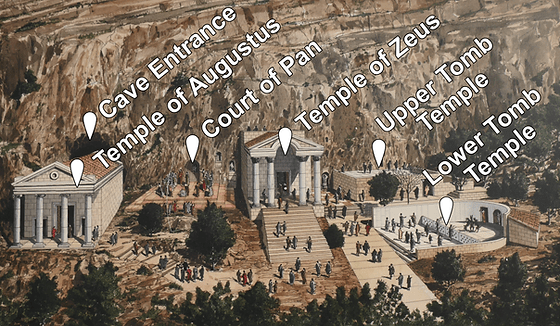
Ok, so first, the location. We’re told that Jesus goes to the region of Caesarea-Philippi, takes the disciples there. And this is strange: because this is the only time they go there, and it is really out of the way, way up in the northern part of Israel. And Jesus doesn’t do anything else there, nothing! No miracles, no cool sermons, nothing. So why? Why there? Well, Caesarea-Philippi is named after two people: Caesar Augustus, the Roman Emperor, and Philip, the son of King Herod the Great, king of Israel. “Ok, why do we care?” So I know we’re all good historians, but real refresher: Caesar Augustus is Julius Caesar’s son, Octavian. After his father is assassinated in the Roman Senate, there is a civil war, a power struggle between Octavian and Mark Antony. And at the battle of Actium, Octavian is victorious and returns to Rome as Caesar Augustus. What he does, then, is pass a resolution in the Roman Senate that Julius was a god—and most people think, “Oh, that’s a nice posthumous thing. Sure! He’s a god.” Brilliant, because Augustus’ next move was to give himself the title “son of god,” because that’s a logical conclusion. And then he set up temple to himself all over the Empire, including in the land of Israel. And where did he put it? Caesarea-Philippi. This place gets the second half of its name from Philip the son of King Herod the Great. So Philip is the son of the king of Israel. And what is one of the titles for the king of Israel? The “son of God.” So what’s the point? Jesus goes to a place infused with, in the shadow of the quasi-divine Roman emperor, the “son of god,” and a place closely associate with the monarchy of Israel, the king-ship in Israel, the “Son of God.” And another important fact: the way that Israel would distinguish their God from the gods of all the other nations was by calling their God the “living God,” as opposed to all these other gods that were just statutes.
So second thing: what does this have to do with Peter’s confession? Jesus asks, “Who do you say that I am?” And Peter says, “You are the Christ, the Son of the living God.” Let’s break it down. The “Christ” (cristos in Greek) is the translation for the Hebrew word Mashiach, or Messiah—which just means one anointed by God. The original “anointed ones,” were the kings of Israel. But in Israel’s history, this title of “anointed one,” “messiah” took on so much more! The messiah, anointed on, Christ was the one God would send to supplant the rulers of the this world. He would be the true king of Israel, so the true and definitive “Son of God.” So listen, Peter says, “You are the Christ, the Son of the living God.” So he’s highlighting that Jesus is this Christ, this new king! And not just the “son of God,” but the “Son of the living God,” the real God.
Ok, three: So put it all together: Peter is making a confession that was revolutionary—in the fullest sense of that word! Caesar Augustus was the “son of god”! King Herod was the anointed king, the “son of the living God,” the true God, the God of Israel! Peter is making a revolutionary confession, an insurrectionist confession, a confession that gets you thrown in prison and killed, a confession that causes civil and social unrest. Why? Because he’s saying “Jesus is king, and Caesar and Herod are not.” And that is something that could get you imprisoned (at least) and executed, crucified (at worst). Our second reading has been from Romans. One of the most controversial lines in Romans is what? “If you confess with your lips that Jesus is Lord and believe in your heart that God raised him from the dead, you will be saved” (Romans 10:9). And it’s controversial because some people think it means, “Just say the words ‘Jesus is Lord’ and believe in your heart of hearts that he rose from the dead—and you get to go to heaven when you die!” But that’s not Paul’s point. In the earliest days of the Church, in the height of the power of the Roman empire—when people would get baptized in those days, their profession of faith was not the creed. When people got baptized by Paul and the apostles, they would “confess with their lips that Jesus as Lord.” And in that world, “Lord” was another title for the Roman Emperor, the Caesar. So to confess “Jesus is Lord” wasn’t just paying lip service to Jesus, it was a way of saying “Caesar is not”—and those were deeply subversive words, that was a deeply subversive confession. And it was a confession that could, that did put your life in jeopardy! This is why Christians were martyred early on: they were believed to be revolutionaries, insurrectionists. They did not recognize Caesar as the “Lord,” or “Son of God.”
Do you see what I’m getting at? Peter’s confession of faith isn’t some strangely inspired theological claim about Jesus being the second person of the Trinity. Peter’s confession is the answer to the question: to what extent does our faith go? And, the answer: to the point of placing your life on the line, to the point of giving your life.
Is Jesus weren’t real, what would change in our life?
The reason I say all of this, and the reason I go to such great lengths to make this point and to show just how incredible this confession of Peter’s is, is because that’s what Jesus is after from each one of us. Many people think of “believing in Jesus,” or “following Jesus” as a nice, trite little something we sprinkle on top of our life—some of us believe that, some of us live that way. But Peter—he shows us that it is so much more.
I was once teaching a class of seventh graders, and one kid asked the question, “What if Jesus wasn’t born? What if he isn’t present? What would change in our life?” And it stopped me dead in my tracks. Because yeah, I could wax on about the theology of original sin, and the human condition, and the necessity of the Incarnation, and salvation, and on and on. But immediately, immediately I thought, I asked myself, “Is Jesus indispensable to me? What does the event of Christ, His presence change in my life? What if he wasn’t actually present for me?” Think: what if you were on the tightrope, in the wheelbarrow with Charles Blondin…and then he just wasn’t there? What would happen? You’d be in deep trouble! Your life would literally be over, it would fall apart! So for someone that has actually placed their faith in Jesus, entrusted their life to Jesus, their life would end, it would not make sense, it would not be livable without him!
Is that how my life is with Jesus? Is Jesus indispensable to my life to that extent? Does his presence actually, concretely change my life? Because if he is, that means I wouldn’t trade him for anything. Like Peter, I would put my life on the line for him. Again, if I’m “in the wheelbarrow,” and Jesus is the one “pushing the wheelbarrow,” I wouldn’t trade him for anything! Because if he isn’t there my life is over.
And this is real! This is the Christian life. I’ve told you before the story of Blessed Franz Jägerstätter. Franz was an Austrian farmer during World War II, a strong Catholic. And like many people of the time, he was drafted into the German army, conscripted to serve as a Nazi soldier. And he refused—he refused to swear an oath to Hitler, his faith in Christ would not allow him to go along with anything that was happening with Hitler and his regime. So he was arrested, charged with treason. And during his imprisonment and trial the Nazi’s kept offering him a way out: sign an oath to Hitler and you can go free. They said, “Sign this, and you can go free.” Even minutes before his scheduled execution! “Sign this and you’re free.” But he calmly and decisively replied with one phrase, “I am free.” What’s the point? This man was offered a chance to save his life—but he knew that his life, his true life was with Christ. And even in chains, even at the point of execution he knew, “I am free. I am alive. Because my life is not in their hands, but in Christ’s.”
A Faith Which Transforms Life
Faith is not something we “lose,” we don’t “lose our faith.” People we know, who have fallen away from the faith, even us at times—faith isn’t something we lose. What happens is we stop shaping our lives by it, we stop entrusting ourselves to Christ. Faith isn’t something we lose, but it is something we can easily set aside in a storage area with all of the other stuff we don’t throw away, but that we don’t really know what to do with it—maybe just get it out at Christmas and Easter to look at.
But that’s not it. Faith is only really faith when it shapes everything in our life; when it shapes our life so much so that, if Jesus weren’t real, if he weren’t present, our life wound’t make sense. Faith is truly faith when it goes to the extent of us placing everything on the line for it, even our life. And yeah, here in Rice County, America—pretty unlikely we’re going to be martyred, literally killed. But are we willing to put other things on the line? Many people in this town have lost friends because they practice the faith, because they say they can’t make it to the lake on Sundays, because they won’t agree with certain ideas rampant in our culture today. Many people in this town have experienced a lot of gossip and innuendo and character assassination because of their faith. On and on. “Blessed are you, Simon,” Jesus tells Simon-Peter. “Blessed are you [here today] when people insult you and persecute you and utter every kind of evil against you falsely because of [him]. Rejoice and be glad, for your reward will be great in heaven” (Matthew 5:11-12). Faith, living our faith, “placing my faith in Jesus” is not just a nice thing to put on a Christmas card, or post about on Facebook, or something that helps me be a nice person who goes to church once in a while. Faith, our faith, true faith in Christ is about placing it all on the line, confident that he gives us precisely what we need, what we truly need—which is more than we could ever ask or imagine.
 The Beggar