
5th Sunday of Easter (B) – April 28, 2024
St. Paul – Lyons, KS
Acts 9:26-31; Psalm 22:26-28, 30-32; 1 John 3:18-24; John 15:1-8
Reclaimed Sundays
As part of our series called The Day the Revolution Began, I announced last week that the concrete proposal for the parish is to reclaim Sunday as the Lord’s Day. And to make that even more concrete, I talked about how we’re going to eat this elephant bite by bite. On the fourth Sunday of every month, for the next twelve months—every fourth Sunday of the month we are going to live that Sunday completely reclaimed for the Lord. Which means much more than just going to Mass (as essential as that is)! It’s about an entire day reclaimed for the Lord. And this is not a minimalism, just making sure we do the bare minimum. It’s about embracing this day for what it truly is: a day of celebration and joy and rest; a weekly Easter. This is something we need! Something we need, our kids, our community desperately needs!
This reclaiming of Sunday—this is our concrete act of revolution against a world, against the mentality of the World that is leading us nowhere—and fast! I’ve said it before, I’m gonna say it again: Jesus’ resurrection was the day this revolution began! On that day, a new hope was born, a new path; a path that isn’t the same ‘ol dead end we’ve been living our whole life; a path that doesn’t lead to increases in suicide and depression and alcohol, no; a path that leads to something new. Finally, something new! But—and this is the key—but this isn’t magic. On our part, it takes a metanoia, a meta-nous: going beyond our current mentality (the one given to us by the World, you know, the one that has proven to be a waste of time)—go beyond our current mentality, embrace a new mentality, and live it concretely. And our concrete action of revolution (and today you’ll begin to see what I mean when I said that this one concrete action will affect 100 others)—our concrete action of revolution is to reclaim Sunday as the Lord’s Day: Reclaimed Sundays.
Why Is This Helpful?
I’ve spent the past several weeks going over why Sunday and reclaiming Sunday is our plan of attack—so you can go back and listen if that’s helpful. But today’s readings give us just a few more, and I just want to touch on this real briefly. In our second reading, John again brings up the fact that words are not enough! “Children, let us love not in word or speech but in deed and truth” (1 John 3:18). Again, it is easy to tell someone that you love them; much harder to live your love for them in real, concrete ways. It’s easy to say you love God and believe in Jesus and follow him; much harder to do that, to keep his commandments, to concretely follow him.
When it comes to our faith, we can’t settle for mediocrity and empty words and the bare minimum, no! So Sunday—we’re going to reclaim it, live it to the full! And this doesn’t mean doing more and more; it doesn’t mean we need to get busier, to have even more to do in our already-too-busy life, no. Our revolution is much more about saying “enough.” Just like America said “enough” when it came to British control, we say “enough” to this mentality that says you will find happiness if you do more: more work, more sports, more TV, more Netflix, more food, more drink, more anything and everything. We say “enough.” Why? Because our happiness isn’t going to come from this Option 1 mentality. It will come only from Christ. “The victory that conquers the world,” John says, “is our faith,” our adherence to Christ.
As Jesus said in the Gospel today: “Whoever remains in me and I in him will bear much fruit, because without me you can do nothing” (John 15:5). Whoever remains in Jesus. Not whoever goes and does a lot of things, and works really hard, and on and on and on—no! Whoever remains. Ten times in seven verses, Jesus just says, “Remain…remain…remain…remain…” What if the thing we need to do—is to stop doing so much—and just remain, rest, abide with him? Just abide. Just rest. Just remain. This will bear much fruit. What if focusing on a living relationship with Jesus Christ, a living communion with him—what if that’s the secret?
Because think, just as one example: think of the witness this will give to our community! People are scared of Evangelization because they think it means screaming at people on street-corners and at the grocery story. But really, this is a powerful form evangelical witness. By reclaiming Sunday in a radical way, you’re proclaiming your faith in Jesus Christ and his resurrection. Think: when the fourth Sunday of the month comes around (or just every Sunday)—on Reclaimed Sundays, you can tell people, “Well, we won’t be able to make it. It’s Sunday, and we have decided to pull back from Sunday whatever”—sports, outings, meetings, work, restaurants, you name it. This gives your permission to say “no.” And sometimes, we just need permission to say “no.” I had an invite just this week, and there was no way I was gonna say “no”! And the only reason I said “no” was because I had previous commitments. We’re bad at saying “no.” Our Reclaimed Sundays are a way to say, “I’d love to. But I have a prior commitment. And that commitment is my faith in Jesus Christ.” That is a powerful witness to others about our faith.
The Proposal
So how do we live this? Concretely? “Go reclaim Sunday” is a tall order. What do we do? Well, it helps to have a guide. Even St. Paul, Saul, in our first reading, “Barnabas took charge of him.” Barnabas held his hand and helped him in those early years. Last week, I gave you a model of what my family did, our weekly Sunday rhythm. But now, it’s your turn! But I’ll hold your hand.
When you walked in, hopefully you grabbed one of my (in)famous handouts!
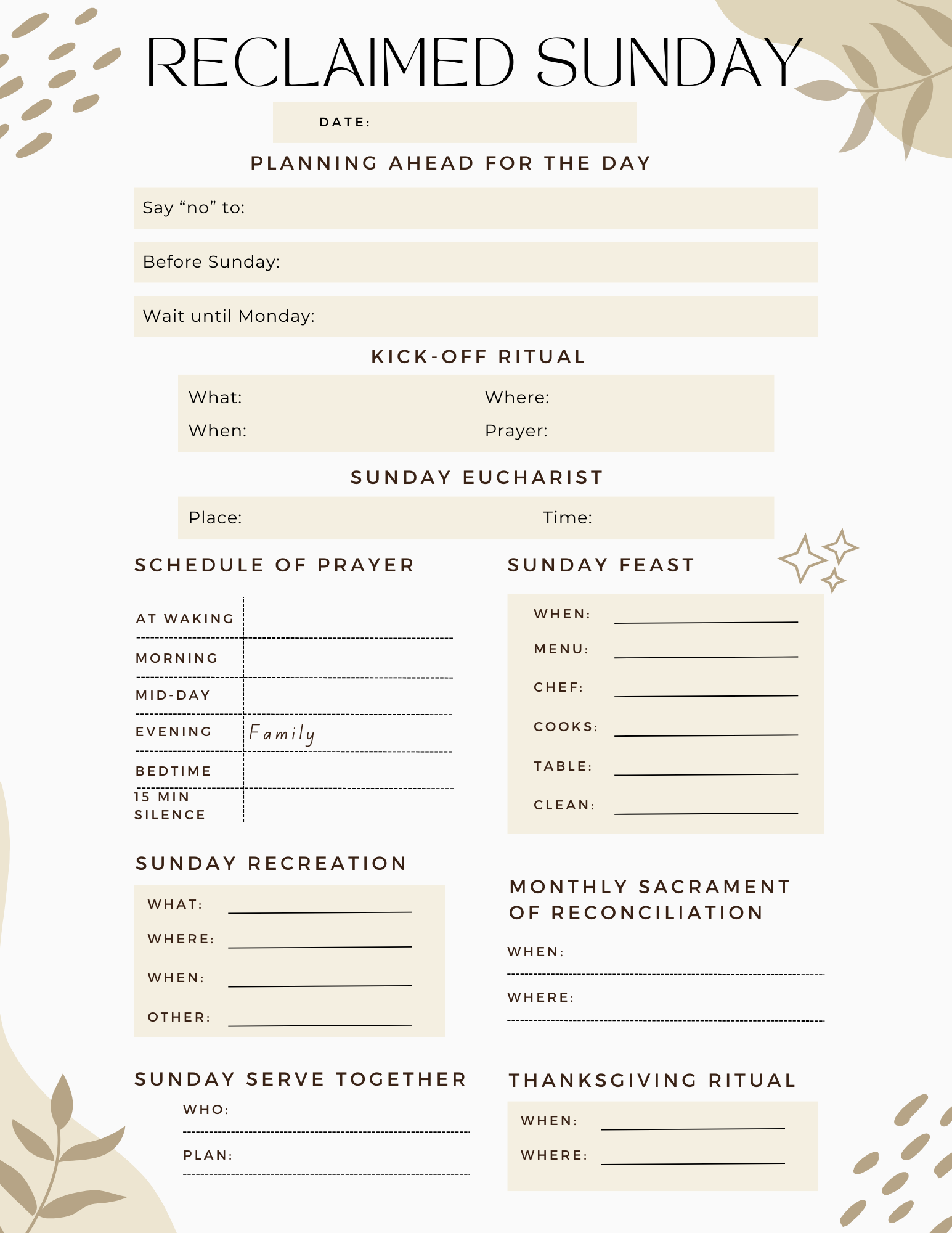
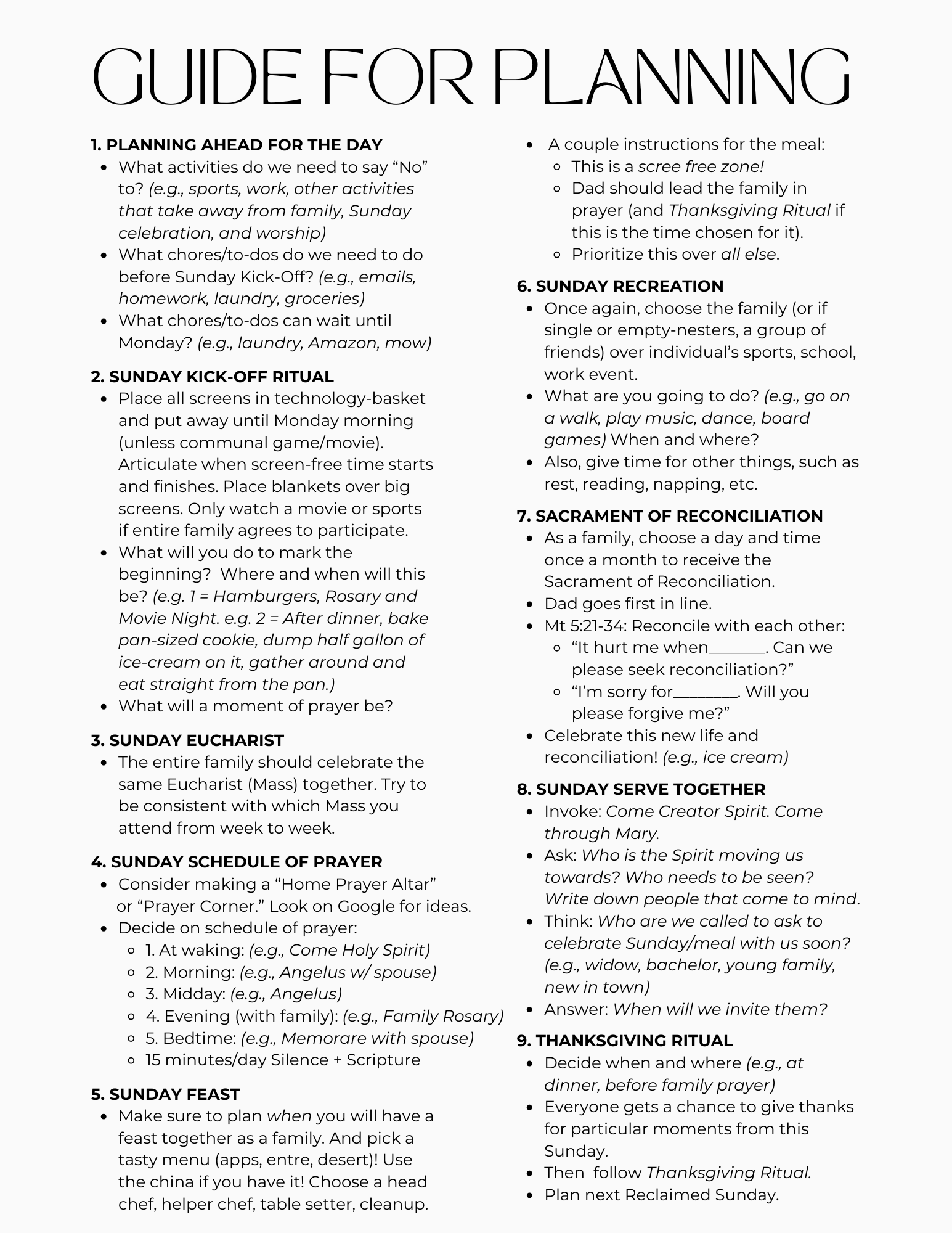
Now, if you were reading it before Mass, you might have had a small aneurism. So take a deep breath, it’s ok. Just look with me real quick, ok? This just gives you nice, simple, practical, broken-down steps to help you develop a rhythm, a structure, a ritual to this day. Why? To help you reclaim it. It’s a battle plan, so to speak. On the back is the explanation, and the explanation helps you fill in the front sheet. I’ll have supplies of these all the time out there. So just look with me:
- Number one is to plan ahead for the day! “If you fail to plan, you are planning to fail,” right? If you have fifty-six things on Sundays that are preventing you from living Sunday well, reclaiming Sunday—well, the first thing you need to do is start eliminating those, right? So, what do I need to say “no” to? Is it sports or other activities that take away from the family, from the Sunday celebration, and from worship? Watching sports is a big one: is twelve hours of NFL football really the best way to reclaim Sunday? Also, what chores/to-dos do we need to do before the Sunday Kick-Off? Maybe it’s homework, laundry, emails, groceries. (Now, some things you have to do on Sundays, like milk cows. Ok. But I would challenge you to ask: how much can I do on Saturday, and how much do I really have to do on Sunday?) What chores/to-dos can wait until Monday? This is the hardest part! Do not underestimate this! And again, see this “no” as a great freedom: when people ask you to do things, to go places, to sign up, to sign up your kid—you can freely and easily say, “No.”
- Ok, second thing. The second thing is to plan a Sunday Kick-Off Ritual. This is what you do on Saturday evening. Like I mentioned last week, my family’s was what? Hamburgers, the Rosary, and a movie. One evangelical pastor I know, his family will begin the Lord’s Day after Saturday dinner by baking a huge, pan-sized cookie, dumping a half-gallon of ice cream on top, and everyone eating it out of the pan. Why? It’s the Lord’s Day! It’s the day of Resurrection! So what about you? What are you going to do? What prayer are you going to incorporate? Where? And when? And some of you probably read this and said “no way” right away to, “Place all screens in a technology-basket and put away until Monday morning. Place blankets over big screens. Only watch a movie or sports if entire family agrees to participate.” In other words, kids shouldn’t be in their room watching something and dad is watching football, and mom is scrolling through Instagram. I’m going to spare you my homily about screens (it’s coming, don’t worry!)—but I think that’s sufficient.
- Third, is the Sunday Eucharist, the Sunday Mass. And that’s the easy one. Maybe not so easy for some is to try to be consistent about which Mass you attend. I’m partial to Sunday morning Mass. But I say “stay consistent,” why? So that Mass isn’t a convenience for us and our day, and our time. Mass isn’t about us. It’s about the Lord.
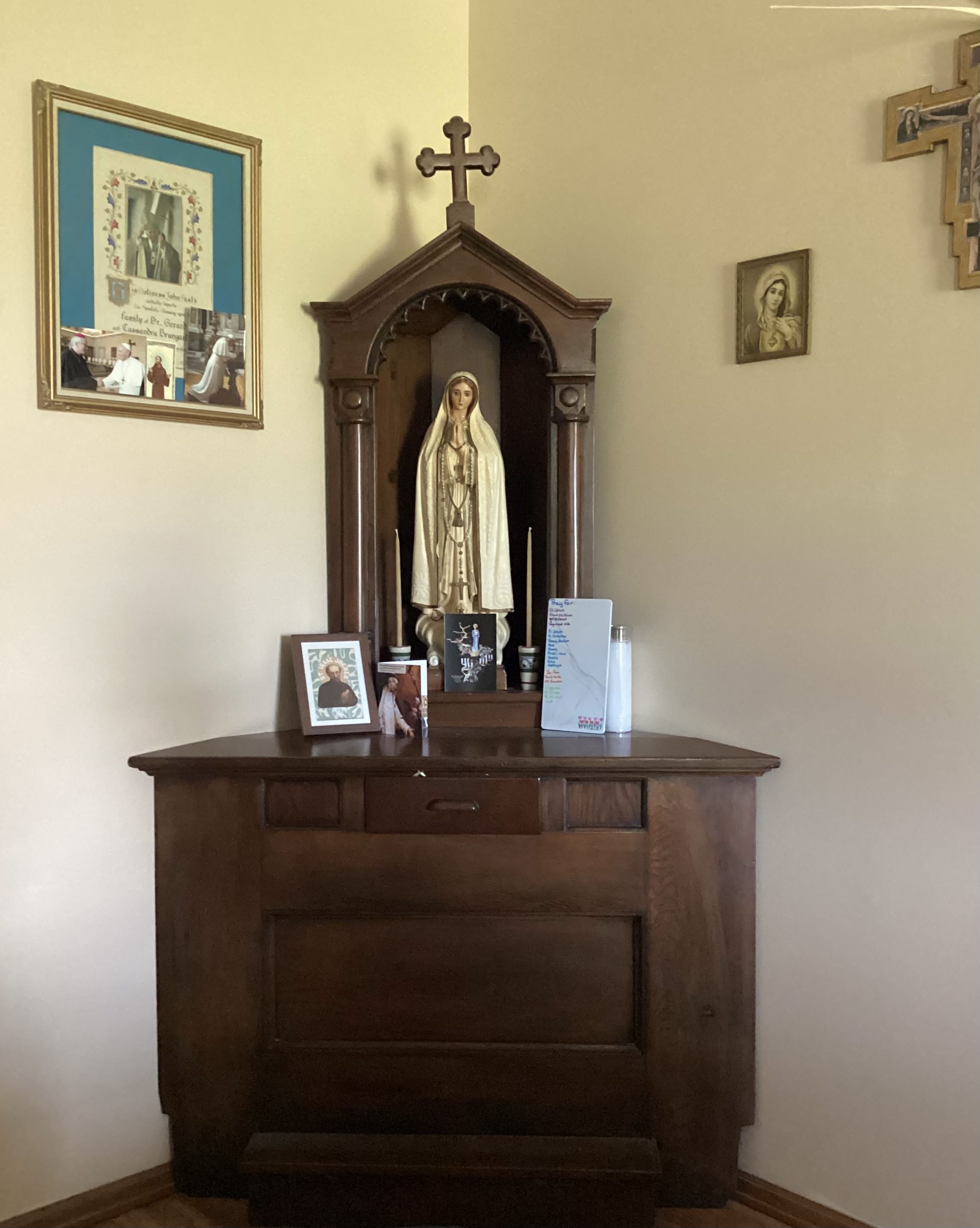
- Ok, fourth. Fourth is to plan out a simple schedule of prayer for the day. We spent all Lent, all “Reconnecting…” talking about prayer. But how’s that going? Anyone make their daily prayer schedule that they follow? No? Ha! See? It’s difficult. So, on one day, we’re going to pray better: when you wake up, in the morning, at midday, in the evening, before bed, and then find fifteen minutes for silence. Two things. One, do you have a prayer altar or prayer corner at home? In our family home, we have a prie dieu that was given to my great-grandfather as a form of payment. It’s a little corner altar with a statue of Mary. Whenever my family would pray the Rosary, we gathered around that prayer altar. But you can google some idea for your home. Two, the prayer in evening should be as a family, sometime after dinner, and that will make more sense here in a second.
- Fifth. Fifth is to plan a Sunday feast. This is easy, and the best part! I would suggest this be an evening meal, but you could also do a huge lunch. The main thing is that it’s a family affair! Or, if it’s just you at home, or you’re empty-nesters, this is a perfect time to invite some people over, gather with a few others. The main thing: go all out! Pick a great menu with appetizers and an entree and dessert. Use your best table-wear, the fine china! Table cloth, candles! Aside from Mass, this should be the other biggest non-negotiable. Prioritize this over all else. You’ll see something there called the “Thanksgiving Ritual”—and we’ll talk about that in a bit.
- Number six is to plan what you will do to enjoy the day. Again, it is going to be easy to say, “Well, we’re all going to watch our son’s baseball games all day Sunday as our recreation”—no, that’s not it. Or, “Well, we really enjoy homework, so we’re doing homework all day.” Again, choose the family (or if you’re single or an empty nester, choose a group of friends) over all these other events. And plan what you’re going to do. Maybe you do watch the Chiefs’ game together, ok! But the key there? Together. Maybe you watch a movie together, ok! Together. You could also just go for a walk, play games. The key: together. Enjoy this time together. Also, leave some time for just relaxing, taking a nap, reading a book.
- Seven—the one you’re going to try to skip—number seven is to plan to receive the Sacrament of Reconciliation once a month. Now, this doesn’t have to be on Sunday, and it doesn’t even have to be on the Reclaimed Sunday. But as a family, begin to find a time to receive this sacrament once a month. Pick a Saturday afternoon and come here at 4:00pm. I would love—absolutely love!—if I started getting complaints that the lines for Confession are too long. I will gladly extend hours and days and times if that’s a problem. This is a beautiful way not just to tell your kids that confession is important, but you model it: mom and dad can go first. And then don’t skip the other part: this can also be the time to make sure you reconcile with each other! Worst (but best) penance I ever got was to go tell my brother I was sorry, and to ask him to forgive me! HA! But wouldn’t have be beautiful? This is a time to reconcile. So, so, so many problems in the world would begin to be solved if people would reconcile with each other. And after this, go celebrate! A little positive reinforcement never hurt anyone! Go get some ice-cream. Blare some music and sing along as you’re going home. Dance party. “Let’s have a feast and celebrate. For this son of mine was dead and is alive again, he was lost and has been found!” (Luke 15:23-24).
- Number eight is to serve together as a family. This one is about using Sunday not just as a day for yourself, but to recognize that we are called to serve others. And maybe not on this day—maybe a different Sunday, maybe during the week. But as part of this, make sure you have a plan about who you need to serve, and a plan for how you’re going to do that.
- And finally, the Thanksgiving Ritual. I’m going to spend a whole Sunday talking about this. And you can grab a sheet out there. But just as an introduction. John Paul II reminded us that “Sunday is not only the remembrance of a past event: it is a celebration of the living presence of the Risen Lord in the midst of his own people” (Dies Domini 31). The Lord is risen, he is risen indeed! And if he is risen, he is present. This Ritual is a very concrete method of noticing the ways the Lord is still here, still at work, concretely. But like I said, we’ll talk about that another Sunday. A simple way to begin is to just ask what people are thankful for from the past week, or even from the day. And you can do it at the Sunday Feast, or before your prayer in the evening as a family.
Reclaimed
And that’s it. Sunday reclaimed! Ok. Be honest. How do you feel? Anyone a little overwhelmed? Scared? Yeah, easy. But again, John Paul II—over and over he would repeat: “Do not be afraid! Open wide the doors to Christ!” Yeah, even our time: open the door of your time to him too. Any time that we give to him is never lost; it is time gained. Sunday is a day which is at the heart of the Christian life. So don’t be afraid. Just continue to beg for the grace to rediscover this day, the Lord’s Day—and again, not just live the precepts and laws of the faith, but to see that this revolution and reclaiming this day responds to the deepest desires of your heart (c.f., Dies Domini 7).
 The Beggar