
6th Sunday of Easter (B) – May 5, 2024
St. Paul – Lyons, KS
Acts 10:25-26, 34-35, 44-48; Psalm 98:1-4; 1 John 4:7-10; John 15:9-17
Love Is Hard
It is very appropriate that we have this Gospel today, especially as these children prepare to receive their First Communion, because it was the same Gospel that was read at their First Reconciliation. Back on the Wednesday or Holy Week, these children received the Sacrament of Reconciliation for the first time, went to Confession for the first time—and this was the Gospel read. On that day I asked them: Do you think it’s easy to be the starting quarterback in the NFL? We all know of Patrick Mahomes, of course. But think, what do you have to do if you want to be a starting quarterback in the NFL? (Is it easy? No!) You have to train a lot, every day! You have to compete. You have to study and prepare. And you have to say “no” to a lot of other things, right? You can’t eat Chick-fil-A every day—you have to say “no” to an unhealthy diet and eat well. When all your friends want to have a sleep-over or stay up really really late, you have to say “no.” In order to be a starting quarterback, it takes a lot of work!
But then we get to this Gospel, and Jesus gives us the commandment of commandments. All of the commandments boil down to this one commandment. And notice, this is not the only commandment, no. This one commandment summarizes all of the commandments. And what’s the commandment? “Love one another…Love one another as I have loved you.” In our day and age, everyone loves to quote this commandment, “Hey, why can’t we all just love each other?” Everyone loves to quote it—but I wonder if people have every really thought through what it means. Because what I think most people mean when they quote it is, “Hey, why can’t we all just be nice to each other?” But is that what Jesus said? No. He said “love.” And in order to love someone—well, that’s hard.
Think: is it easy to be the starting quarterback in the NFL? No! And we know that if you want to do that it takes time, energy, sacrifice—on and on and on. But then, when we’re commanded to love as Jesus himself loves—in other words, when we’re commanded to love with a divine love—why do we assume that this is easy? Think: is it easy to be married? Is it easy to love your spouse every day? To honor them, respect them? In good times and in bad? Our second reading and our Gospel—over and over we hear about love, and God is love, and remaining in that love—and it’s beautiful! But what did Jesus say this means? “Remain in my love [beautiful!]. If you keep my commandments, you will remain in my love, just as I have kept my Father’s commandments and remain in his love.” Just like if you want to be an NFL quarterback there is a long and difficult path to follow, it’s the same with living this divine love. Jesus’ commandment of “love” isn’t a blasé “be nice to each other.” Love is hard.
And for the last four weeks, we’ve been talking about one of the ways this can be so difficult. One of the simple—simple, but incredibly important, revolutionary—commandments of God is “to keep holy the Lord’s day.” Last Sunday we had our first “Reclaimed Sunday,” our first attempt to reclaim the whole day for the Lord. This is a concrete act of love: love of God, but also love of our families and children. Just like you tell your kids they need to go to school, or eat vegetables, or go outside and play—why? so that they are healthy—just like you lead and guide your family in that way, helping them to reclaim Sunday is a concrete act of love for them. So just think: how did is go last Sunday? was it easy? did you do everything on the Reclaimed Sunday sheet? did you feel a tension at times? was it uncomfortable? “To love” is much more difficult than “being nice.” So I just want to encourage you to keep it up, don’t become discouraged!
His Real Presence Remains
Reclaiming Sunday is about reclaiming the whole day, and that sheet will be really helpful to do that. But one thing I want to talk about today, though, is the Sunday Eucharist, the Mass. Yes, we all know that as Catholics we have the obligation to attend Mass each and every Sunday (unless there is a grave reason for missing, like we’re sick or an emergency happens)—we know this. But long before the Church made this an official precept—long before that, people were willing to risk death in order to attend the Sunday Eucharist—literally, risk death. We can easily turn Mass into something we have to do, or something we do when we feel like it or we need to feel closer to God. But since the beginning, followers of Jesus gathered every Sunday (even when it meant risking their lives)—they gathered every Sunday to celebrate the Eucharist. Why? Because the Sunday Eucharist wasn’t just a time to remember something that happened long ago, or to enjoy a nice homily, or to see friends. Sunday was a celebration of the presence of the Risen Lord in the midst of his people (Dies Domini 31). Jesus, because he is risen, is still present. And the most fundamental way he was present? In the Eucharist, in the Breaking of the Bread (as it was originally called). In the Acts of the Apostles, right after 5,000 people are baptized, we are told that they all dedicated themselves to four things: the teaching of the Apostles, the community, the prayers, (and?) the Breaking of the Bread, the Sunday Eucharist. This was essential since the day of Pentecost, the day the Church was born.
And from that day, they were also willing to risk death in order to participate in the Sunday Eucharist. The New Testament (the Acts of the Apostles in particular) is full of people risking their lives in order to live and practice their faith. Why? This is their concrete act of love—and love isn’t easy, definitely not just “being nice.” From around 150 A.D. (so only one hundred years after Jesus) there is a document from an early saint of the Church, St. Justin Martyr. And St. Justin wrote how, already, the practice of the Christians gathering every Sunday for the Eucharist was firmly established. A few decades later, the Emperor Diocletian banned these gatherings with incredible severity—and yet the Christians were courageous enough to defy the emperor’s decree, and even accept death rather than miss the Sunday Eucharist. There is a famous story of the martyrs of Abitinae; 49 Christians were found guilty during the reign of Diocletian of celebrating the Sunday Eucharist in defiance of the emperor’s law. And what was their reply in court? “Without fear of any kind we have celebrated the [Eucharist] because it cannot be missed; that is our law.” And then they said this, “We cannot live without the [Eucharist].” Even during torture, they would not renounce their faith in the Eucharist.
And this has continued even to this day! Just a few decades ago, during the rule of Mao Zedong in China, Catholics were forbidden from gathering. Churches were destroyed. The story I tell about the man from China—this is when he lived. There is another famous story of a little girl. After the soldier came into the small village church, desecrated it, and thew the Eucharist all over the floor, this little girl (only 7 years old) snuck in every night, made a holy hour, and consumed one host—for 32 nights in a row. On the last night she was caught, and then beaten to death. She was willing to risk her life for the Eucharist—not just pieces of bread that help us think of Jesus. The Risen Lord, present with us through this sacrament; really, truly present.
In the Eucharist, at the Sunday Eucharist, Jesus remains present, our Risen Lord remains present. And since the beginning, Christians have been willing to risk their lives to come to this altar each and every Sunday. Our brothers and sisters in this “revolution” have given their lives to be here. Look at how excited these kids are? All ready, all prepped. Family and friends are here, you’ve made sacrifices to be here, bought nice clothes, planned a party. Why? Because it’s worth it. Jesus Christ is worth it. Don’t lose that desire. Don’t forget.
Prepare for Mass: The Beggar Questions
But it’s easy to forget this excitement, right? Just like marriage can become tedious, jobs that we love and enjoy can become tedious, practicing for games can become tedious—it’s easy for us to start coming to Mass because we have to. And we just check off a box. I get it! Trust me, I get it. So this is why one thing I wanted to give you are these questions, what I call the “Beggar Questions.” This is a sheet you can leave in your car, and on your way to Mass, or when you’re here for ten minutes in silence before the Mass begins—these questions can help you remember, remember why you come, what you’re looking for, what Jesus can do for you, what we need to do to prepare for this. Everyone knows that Jesus is the right answer, right? Of course. But what are the questions? What are the questions within our heart? Well, Jesus asks us. So just look with me real quick.
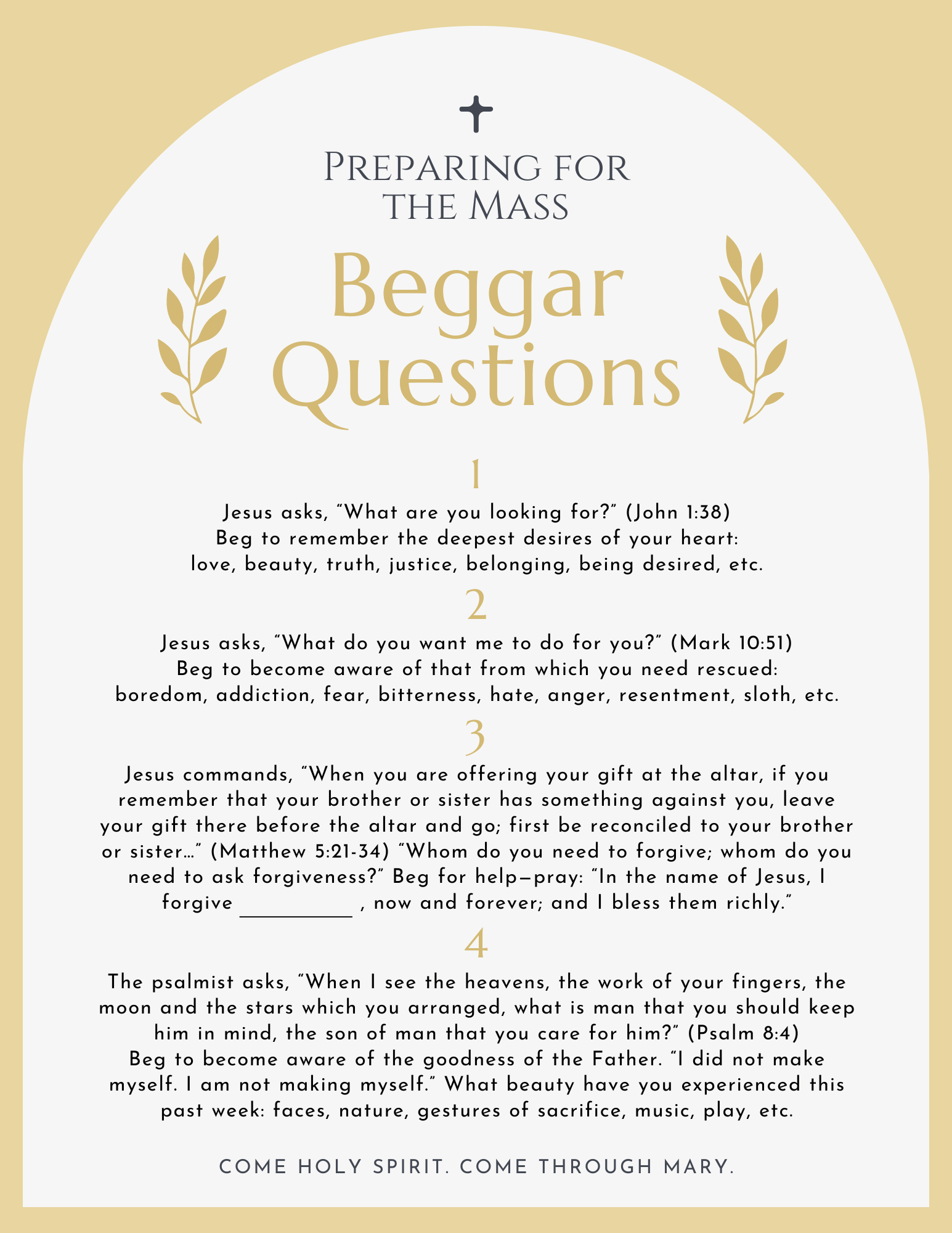
The first question is, “What are you looking for?” These are the first words out of Jesus’ mouth as he begins his public ministry. And so ask yourself, especially as you’re preparing for Mass, this profound encounter with Jesus: what are the deepest desires of my heart, what am I truly looking for? During the week, it’s easy to get distracted by many things, to get overly-focused on desires we have that are not so important. We get distracted by work, kids, schedules, events, the business of it all. We get distracted by desires for money, and stuff, and pleasure, and power, and control. But as we prepare for the Mass, this is a time to beg to recall, and to really own once again: “Why do I even come here? Oh yeah, because Jesus responds to the deepest desires of my heart.” I’ve shared that quote from St. Augustine with you before; he says, “The entire Christian life is an exercise in holy desire.” What are you looking for? What is your deepest desire?
The second question to help us prepare is, “What do you want me to do for you?” Jesus asks this to the blind man Bartimaeus, a man who was crying out, “Lord, have mercy!” (Words that we say at the beginning of every Mass, right?) So this second question is us begging to recall, “What do I need rescued from?” What is our “blindness?” What is the condition we have that we cry out to Jesus, “Lord, have mercy!” Maybe it’s boredom; life is just boring and flat. Maybe it’s bitterness, or hatred, or anger. Maybe it’s anxiety. Here at Mass, don’t just come and put your butt in a pew; beg, cry out like Bartimaeus, “Lord, have mercy! Rescue me from ______.”
The third question is a reflection based on something Jesus commands. Right at the beginning of the Sermon on the Mount, Jesus talks about how he has not come to abolish the law (so he didn’t say, “Hey, forget everything. Just be nice.” Nope!) Jesus says he hasn’t come to abolish the law. And his first example? Murder. Classic! He says, “Yeah, murder? Still off the table.” But then he intensifies it; he says, “You have heard that it was said to your ancestors, ‘You shall not kill; and whoever kills will be liable to judgment.’ But I say to you, whoever is angry with his brother will be liable to judgment.” And then he says, “When you are offering your gift at the altar, if you remember that your brother or sister has something against you, leave your gift there before the altar and go; first be reconciled to your brother or sister.” The question for us is, “Whom do you need to forgive? And from whom do you need to ask forgiveness?” And then beg for help to do this. I can tell you, even though you already know: there are hurts and grudges and resentments and anger in this community that are ripping it apart. Many of you here today—there is someone very close to you that you no longer talk with, or that you don’t want to see. But notice: forgiveness and reconciliation are not the same thing. Jesus commands us to forgive, yes; you can always forgive someone else, release them from the “debt” they owe you. But reconciliation is different: that’s a two way street. If a person has done something wrong to you, they need to own up to that and change before you and them can begin to fix things. And notice Jesus’ command, “If your brother or sister has something against you.” In other words, if you are in the wrong, you need to go ask forgiveness; you need to go own up to what you did, ask forgiveness, begin to change. This is a big one.
Fourth, we read in the Psalms about a man looking up at the night sky, just filled with wonder and awe at the vast expanse of space, the billions of stars. And as he’s looking he asks, filled with wonder and awe he asks, “What is man that you should keep him in mind, the son of man that you care for him?” In other words, “God, I am so, so, so small—and yet you know me, you know my name, you care for me! Why? What’s so special about me?” The thing to beg for is to recognize all of the ways that the Father shows his goodness to you. This is an exercise in wonder and thanksgiving. The word Eucharist means “thanksgiving.” At the center of our life is an act of thanksgiving. And so notice: “What beauty have you experienced this past week?” How had the Father made his goodness known?
“Remain in my love”
Again, look at these first communicants: stoked! What if we could come to this Eucharist every Sunday with that same intensity of desire, that same expectation? These questions are meant to help us prepare, to rekindle that once again. This is the work on our part.
Like I said, it’s easy to say you want to be a starting quarterback in the NFL—much harder to follow the path to that. We can all easily say that we want to be a person of love—much harder to do that. It begins by coming to this Eucharist, coming to the Sunday Eucharist each and every Sunday, making this the focal point of our week, of our life. Look at the witness of all of those who came before us, those willing to die in order to be here. We make huge efforts to be at work, at school, at track and football and volleyball and basketball and softball practices—we know what it takes to “be on the team.” And it’s the same with Love, with Faith—we come. And with greater intentionality, with greater desire, we come to receive what only he can give.

