3rd Sunday of Lent (C) – March 23, 2025
St. Paul – Lyons, KS
Exodus 3:1-8a, 13-15; Psalm 103:1-4, 6-8, 11; 1 Corinthians 10:1-6, 10-12; Luke 13:1-9
The Challenge: Not Just Navel Gazing
With just a few more weeks of our series called “Renewing…”—this series in which we’re seeking to encounter the healing power of Jesus Christ in our lives—we’ve discovered a few challenges. One of them is understanding that “healing” does not mean “fixing.” Another is the challenge of just simply acknowledging that we are wounded—even if we haven’t gone though serious trauma in our life. We’ve talked about the challenge for forgiveness; about needing a healing that goes to the roots—truly getting at the core of things. Last week, the challenge of persevering in this work, even when things are difficult.
One other challenge for today, then, is the challenge of just the discomfort of what some would call “navel gazing.” Doing all of this work on yourself can seem a little weird; “Aren’t we supposed to be thinking about others?!” But I get it! For one, it is very uncomfortable working on yourself. Trust me, I know; I spent six years in seminary, and that seemed like constant “navel gazing,” always working on yourself. ‘Cause yeah, we would rather ignore our problems and focus on others. But think: what did we hear in the Gospel just three weeks ago? “Why do you notice the splinter in your brother’s eye, but do not perceive the wooden beam in your own?…Remove the wooden beam from your eye first” (c.f., Luke 6:41-42). So Jesus seems to endorse doing this work on yourself first. But again, you’re right, it’s not comfortable doing this work, it’s not fun addressing your personal problems.
But two—aside from it being not fun—two, we can easily start to have that feeling, “This feels very self-centered.” And yes, but no. If your husband is having issues, and those issues begin affecting your marriage and your family—is it self-centered of him to make a serious effort to work on those things? No! It will actually make him a better husband! Is it self-centered of me to pray and study? No! It will make me a better priest. So in the long-run its good.
But your instinct is right: all of this is just the means to an end. Ultimately, this work of healing, of addressing our wounds and problems and sins, taking time to very intentionally invite Jesus Christ to work powerfully in our heart—all of this is a preparation, a “cultivation of the soil”, a healing “at the roots”—why?—so that you can bear good fruit. Like we heard in the Gospel today: if we’re not bearing fruit, we’re doing something wrong. We’re exhausting the soil, it is better for us to be chopped down. But in his mercy, the Gardener (a.k.a. Jesus) comes to cultivate and fertilize—he comes to heal us at our roots (why?) so that we can bear fruit.
The goal of this series is not to become neurotic about our problems, to become scrupulous and filled with anxiety about the many issues we face, no. The goal is to experience a healing so that we can bear the fruit, the good fruit, that Jesus wants us to bear. But—but we cannot skip the step of healing. The health of the “tree” has to be addressed or else the fruit will be bad. Our spiritual health, the health of our hearts and souls—this health and healing has to come first.
Start with “Why” & The Law of Diffusion of Innovation
One place that I have learned this very important lesson about the importance and necessity of health—it was actually from the world of business. One of these business health gurus is a guy by the name of Simon Sinek. And Simon swears by two principles (and because all truth ultimately has its origin in God, who is Truth itself, the truth of these principles are sort of knit into the very fabric of the world, so they’re helpful for us in our faith as well.)
The first principle he swears by is the principle of “Starting with why.” And simply put, this is the principle of always leading with a why, why you do things, not just what the thing is you’re doing. Think about it this way: if you’re on a plane and someone sits down to you (and their a talker—the worst!) what is one of the first questions they’re going to ask you? “So, what do you do?” If they ask you and then you go, “Oh, I’m a chiropractor.” They’re going to go, “…cool.” Because except for the 10% of people who like want to talk to a chiropractor, that conversation is over—because nobody cares about what you do. And if you’re kind and ask them, “So what do you do?” And they say, “I’m in marketing,” you’re going to go, “…cool.” Conversation over. But—as Simon point out—but what happens when you lead with “why.” If in that hypothetical plane conversation—if you say, “I love what I do every single day. I help people find ways to live a more inspiring life.” They’ll say, “Oh wow, how do you do that?” And you say, “Believe it or not, I’m a chiropractor”—then you spend the next 25 minutes talking about that. But what caused that shift? What caused them to be so interested, to buy in, to want to know? You started with why—why you do what you do. So starting with “why”—very important.
The second principle Simon swears by is called the Law of Diffusion of Innovation. Simply put, this means that all populations shift across the standard deviation, the bell curve. For example, you have some people that are super smart, some people that are super dumb, but then most people are in that middle part—you have an average, always, right? Or, in the church right now there is a percentage of people nodding thinking, “Man, I love Fr. Michael.” And there’s a percentage of people thinking, “When is this going to be over?” And then most people are in the middle with kind of an open mind. So, the law of diffusion of innovation says that the first two percent on the curve are your innovators: like Steve Jobs—Steve invents the iPhone. The next group are called the “early adopters,” these are the people that got an iPhone really early on. The next two groups in the middle are called the early and late majority: these are the people that saw that everyone had an iPhone, so they got an iPhone too. And then the last group are called the “laggards”—the only reason they got an iPhone is because their kids forced them to have one, and they still hate it. Ok, the reason I bring this up is because it helps us to understand how nothing happens all at once: it takes time. And the innovators and early adopters are always going to seem a little weird, but little by little the early and late adopters will eventually join in.
So two principles: start with why, and the law of diffusion of innovation.
Moses: An Early Adopter Given the WHY
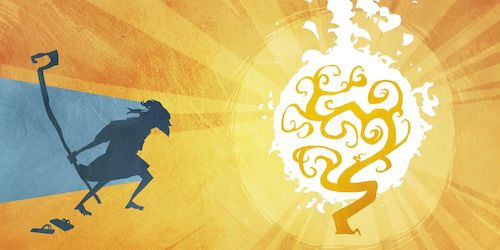
Ok, so why do I bring that up? I bring it up because like I said, all truth ultimately comes from God and this precisely what we see happening in our first reading. Again, the very famous scene where God appears to Moses in the burning bush—we’ve all heard about it! But what is really going on? Well remember, Moses grew up in the house of Pharaoh, pretty much his adopted son. But after a few incidents, he was forced to run for his life. And he went to Midian, got married, settled down. (And that’s us! Just trying to live our lives.) But one day, on this day, while taking care of the flocks, he saw this miraculous sight: a bush on fire but not consumed.
But notice what happens. When God speaks—what does God begin with? (Again, this is the first time God speaks to Moses—very first time!) God identifies himself, “Hi, nice to meet you, I’m God—‘I am the God of your fathers, the God of Abraham, the God of Isaac, the God of Jacob.” And then God says this, God leads with why, why He’s speaking, why He’s doing this, “I have witnessed the affliction of my people in Egypt and have heard their cry of complaint against their slave drivers, so I know well what they are suffering. Therefore I have come down to rescue them from the hands of the Egyptians and lead them out of that land into a good and spacious land, a land flowing with milk and honey.” Boom! That’s they why!
But then, immediately, God says, “Now, go! I am sending you to Pharaoh to bring my people, the Israelites, out of Egypt.” God invites Moses to take on this why. God is the “innovator,” but Moses is the “early adopter.” And what does Moses do? He says, “Yeah, people aren’t gonna get on board with this very easily.” But God encourages him, and Moses—again, an “early adopter,” crazy enough to take a risk, courageous enough—Moses goes for it! And we know the rest of the story: through the action of Moses, God rescues His people! Little by little, everyone buys in—even the “laggard” Pharaoh.
So think big picture: what’s really going on? After beginning with why, God and his “early adopter” Moses—they bring about the “fruit” of this rescue from Egypt.
The Goal: To Bear Fruit
Ok, this is what I’m getting at for us. The challenge for us is that we have to be a little “crazy”—kind of like Moses. Again, I’ve mentioned this before many times—we are living in a time where you can’t just casually be a Christian, a Catholic. No, it has to be very intentional. And this is very new for us! We—even just a few years ago when I grew up—we were used to just going with the flow. But those days are gone. And this is the why: I have a desire for everyone to have a life-changing encounter with Jesus Christ and to radically live out the gospel message so that they can experience the abundant life offered by Jesus Christ. Great, that’s the why. But now comes the “early adopters”: even though not everyone is doing it yet, we have to be a little “crazy,” a little courageous, and live our faith in bold ways.
And I know that temperamentally many of us are not inclined to that. But this is where, like Moses, we have to allow ourselves to be challenged to step out of our comfort zone, our comfortable little life. And so first and foremost, a bad tree will not bear good fruit—we need to address our need for healing, healing at the roots. And secondly, we have got to start going to Jesus in serious ways: Mass every Sunday, Adoration regularly if not once a week, prayer every day, fasting, almsgiving, Confession regularly (like once a month even). We have to start taking this stuff seriously—why?—because if we are every going to bear fruit we have to address the roots, and cultivate the soil.
Healing: A Preparation for the Mission/Fruit God Has Entrusted to You
Because remember: this healing is not just for you to feel better about yourself, no. It is (ultimately) about our ability to bear fruit—a fruit only you have been created to bear. Just like Moses, God has created you for a reason, a purpose. But are we willing to say “yes”? St. John Henry Newman wrote a prayer to this effect (and I’ll close with this, and it’s on your handout)—John Henry Newman wrote a prayer about fulfilling this call. And you can follow along:
“God has created me to do Him some definite service. He has committed some work to me which He has not committed to another. I have my mission. I may never know it in this life, but I shall be told it in the next. I am a link in a chain, a bond of connection between persons. He has not created me for naught. I shall do good; I shall do His work. I shall be an angel of peace, a preacher of truth in my own place, while not intending it if I do but keep His commandments. Therefore, I will trust Him, whatever I am, I can never be thrown away. If I am in sickness, my sickness may serve Him, in perplexity, my perplexity may serve Him. If I am in sorrow, my sorrow may serve Him. He does nothing in vain. He knows what He is about. He may take away my friends. He may throw me among strangers. He may make me feel desolate, make my spirits sink, hide my future from me. Still, He knows what He is about.”
 The Beggar