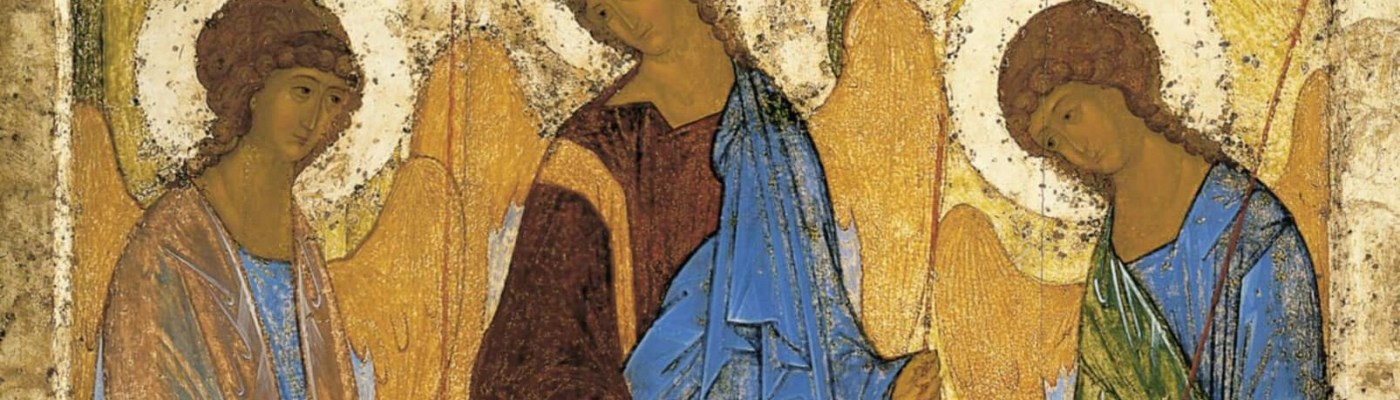
The Solemnity of the Most Holy Trinity – May 31, 2026
St. Joseph – Wichita, KS
Exodus 34:4b-6, 8-9; Daniel 3:52-56; 2 Corinthians 13:11-13; John 3:16-18
Trinity Sunday
Today we celebrate one of the most important solemnities of the entire Church year: the Solemnity of the Most Holy Trinity. And if we’re honest, for many Catholics this feast can feel a little strange. Christmas makes sense. Easter makes sense. Pentecost makes sense. But Trinity Sunday? It can feel like we’re being asked to solve a theological math problem.
Three Persons. One God. Not three gods. Not one person. Three Persons. One God. And immediately we start trying to figure it out. We reach for analogies: Water, ice, and steam; the three-leaf clover; the sun, its light, and its heat. And usually the result is that we end up accidentally inventing a heresy.
But here’s the thing—and it took me a while to accept this. But here’s the thing: the Trinity is not a problem to solve. It is a mystery to live. Simple as that. The Trinity is not a problem to solve, to explain, to wrap our minds around, no. The Trinity is a mystery we are meant to live, a mystery in which we are called, called to share, called to participate, called to live.
The Ring of Power
As many of you know—I’ve mentioned this before—one of my favorite series of books, series of movies is The Lord of the Rings, that masterful trilogy by J.R.R. Tolkien. One of the incredible things about Tolkien’s trilogy is the way he weaves a story out of deeply Christian themes, so much so that it reveals deep Christian truths to the reader. And not like C.S. Lewis and the Chronicles of Narnia—Aslan is Jesus, the White Witch is Satan. No, it weaves deeply Christian themes into this epic tale.
At the center of the whole story is? The ring of power. And notice: it’s not the ring of pride, although that’s related; it’s not the ring of gluttony, or money, or lust. Power. Tolkien’s great insight is that the deepest temptation we face, our deepest darkest urge—it’s a grasping at power. And over and over you see people making the same argument, “Let’s use the ring for good! If I had it, I would use it for good!” Boromir says it. Galadriel is tempted by it. Gandalf won’t even touch it. Everyone thinks that they could wield this power. Everyone thinks, “I would be different!”
But what happens to each and every person that possesses the ring? They are corrupted. Gollum famously so. He has it for so long, he shrivels up into this ghoulish creature. Lord Acton, Tolkien’s compatriot, famous quipped, “Power tends to corrupt and absolute power corrupts absolutely.”
And we fall into this every day! This is why Tolkien’s story isn’t just a nice story—it reveals us to ourselves. That’s why it’s good literature: it reveals us to ourselves. We aren’t in possession of the ring of power, we aren’t presidents and generals. But we do have a ring of power. Think about how you think about your life. “What am I going to do with my life?” “I have my plans, my hopes, my dreams.” We ask kids that, “What are you going to do with your life?”
I grew up in an incredibly Catholic family: ten kids, homeschooled, daily Mass, daily Rosary, family dinners, adoration—all of it! But when I heard God’s call to the priesthood, my initial response was not, “Wonderful!” My response for years was, “No.” Why? Because it didn’t fit my plans. It didn’t fit the narrative I had written for my life. The issue wasn’t whether God’s plan was good. The issue was control. Power. I wanted the Ring.
Over the years, I’ve walked with many women and families who have experienced abortion or contemplated abortion. Not once—not a single time—has anyone ever told me, “I just wanted to kill a baby.” Not once. But I have heard versions of this countless times: “This wasn’t supposed to happen. This wasn’t my plan. My life wasn’t supposed to go this way. I just wanted things to go back to normal.” Good, faithful Catholics who went to Mass every Sunday, had kids in Catholic school—this is what they would tell me.
You know I love bringing up COVID. How many times did we hear people say, “I just want things to go back to normal”? Why? Because reality had escaped our control. The deeper issue wasn’t simply inconvenience. It was power.
Daily we choose our way over God’s way. We call that “sin.”
Why do we get so wrapped up in politics? Because politics promises power. Politics promises control. Politics promises that if we can just get the right people elected, pass the right laws, seize the right levers of influence, then we can finally fix everything. The temptation is always the same: We can solve the problems of the world. How? Power.
Trinitarian Life
But then we come to day’s solemnity. The Trinity. (Again, by our own power we try to cram this mystery into our head, explain it, solve it!) But at the heart of this solemnity is the great mystery that the grounding of all being— So, as Thomas Aquinas points out to us, God is not ens summum, the highest being, the biggest thing there is, the greatest being among many. Thomas Aquinas says that God is ipsum esse, the sheer act of “to be” itself. God is the grounding of all being. And what is that grounding? The scriptures say, “God is love” (1 John 4:16). The Catechism beautiful summarizes it this way: “God himself is an eternal exchange of love, Father, Son and Holy Spirit” (CCC 221). God is omnipotent, all-powerful, yes. But how does God exercise power? How does God’s power work? What is the grounding of all being? Love. So how does God’s power work? Through love.
Look at our readings, look at God’s revelation to us. In our first reading from the book of Exodus, God describes Himself to Moses as: “merciful and gracious, slow to anger, rich in kindness and fidelity” (Exodus 34:6). These are not the attributes of domination, but of patient, enduring love. In our Gospel, the Gospel of John, perhaps the most famous line in all of Scripture: “God so loved the world that he gave his only Son.” Jesus doesn’t say, “God so conquered the world.” He doesn’t say, “God so dominated the world. God so forced the world.” Nope. “For God so loved the world,” he did what? “He gave his only Son.” Gave him, “not to condemn the world, but that the world might be saved through him” (John 3:17). Gave him up to death.
The Trinity is not merely the highest being among other beings. God is not simply the biggest thing in the universe. God is Being itself. The source of everything that exists. The foundation of reality itself. And at the heart of reality is not competition. At the heart of reality is communion. At the heart of reality is love. “God is love.” Not, “God has love.” Not, “God occasionally acts lovingly.” God is love. That beautiful summary from the Catechism finishes this way, “God himself is an eternal exchange of love, Father, Son and Holy Spirit, and he has destined us to share in that exchange.” We are destined, our destiny, our goal, what we are made for—is to share in that life.
What that means—to become like God doesn’t mean acquiring more power. It means becoming capable of greater love. It means becoming merciful, patient, faithful, generous. It means becoming capable of sacrifice. It means becoming capable of giving not merely what is easy, but what is precious.
Power vs. Love
But this, then, is where the disconnect happens! The disconnect between our faith and our life. We see it all the time: people go to church, but they grow up and leave the faith. Or worse, they come to church, but then walk out the doors and live as if the faith doesn’t matter. And it’s not a problem of morals—we all struggle with temptation and sin. The issue? The issue is that they hear one thing here—“God is love. Love your neighbor as yourself”—but then they walk out the doors, and for six days and twenty-three hours of the rest of the week they hear, “What are you going to do with your life? What are your plans?” They run into the mentality of the world, a world which teaches power, control, influence. One of the bestselling books of all time is How to Win Friends and Influence People,Dale Carnegie. Notice the goal: influence, power, impact, control.
But what is proposed to us by our faith? Love. Our job is not to change the world. Our job is to love the world—even as it is. This is massively more important. And what did Jesus change? Over time, everything.
Just notice how you feel when you hear that! That sounds weak. It sounds passive. It sounds unrealistic.
But look at Jesus. What did Jesus do? Did He seize political power? No. Did He overthrow Rome? No. Did He lead a revolution? No. Peter wanted that. Remember when Jesus predicted His Passion? Peter rebuked Him. “God forbid, Lord!” Peter was saying, “Lord, this is not how power works. We can put You on a throne. We can build a kingdom. We can take control!” And what does Jesus say? “Get behind me Satan. You are thinking not as God does, but as human being do, as the world thinks” (cf. Matthew 16:23).
Peter couldn’t wrap his mind around how the world would be saved through sacrifice, weakness, crucifixion, death. The cross is the place of ultimate powerlessness: you are naked and exposed, pinned down, dying. And yet this is the throne of Christ, this is the place his power is most revealed. What does Jesus say to St. Paul, when Paul is trying to control his life? “My power is made perfect in weakness” (2 Corinthians 12:9). And so Paul tells us, “And so I boast most gladly of my weaknesses, in order that the power of Christ may dwell with me. Therefore, I am content with weaknesses, insults, hardships, persecutions, and constraints, for the sake of Christ; for when I am weak, then I am strong” (2 Corinthians 12:9-10).
The world always teaches that seizing power is the answer. Marx said that. Control the economy, control the institutions, control society—then things will get better. None of you think Marx is the guy to follow, but implicitly we often do. Napoleon said it. Conquer enough territory and you can reshape history. But Christianity says something different: the force that changes history is the same force that makes us happy: Love. And that force became flesh in Jesus Christ.
The Witness of Warren Farha
I know this sounds pie in the sky. I know how uneasy this makes us feel, especially as Americans. But that’s the issue: American is built on the ideal of power, self-determination, autonomy, control, manifest destiny!
But look at true witnesses. I think of Warren Farha, the founder of Eighth Day Books. Warren passed away last week. I had the privilege of attending his funeral over at St. George’s. But Warren—Warren’s life was not one of power. If you met him, he was a small, unassuming, meek figure. He ran a little bookstore. But he lived his life as a life of love. He was deeply committed to Jesus Christ. By the end of his life, thousands upon thousands had been deeply affected by him. My entire intellectual history and formation would have been severely impoverished if not for Warren. And over a thousand people were at his funeral. He didn’t try to change the world, he simply loved it.
But do we do that? Or do we continue to seize power?
I think about our fight against abortion. After decades of political effort, Roe v. Wade was finally overturned. And people rejoiced! Catholics and Christians patting themselves on the back. After decades of machination, strategizing, “holding our nose” as we elected candidates that would stack the Supreme Court correctly, people behind the scenes putting forward candidates for the Supreme Court, building legal cases that would get run up to a favorable Supreme Court—after all that recourse to power, finally the Dobbs decision overturned Roe.
And what changed? Nothing. Actually, things got worse. There are more abortions now than before.
The early Christians—they lived in a world where abortion was legal, where you could put your newborn baby on the trash if you didn’t want it. Did they sue Rome? Try to gain power? No. They picked up abandoned babies. They cared for them. They loved them.
Or think of slavery. We’ve passed laws. We’ve won court cases—Brown vs. The Board of Education. We’ve outlawed discrimination. And thanks be to God for that! But? But there are more slaves in the world today than at any other point in human history. Forced labor. Sex trafficking. Children working in the Mica mines of Africa? Why? For our smartphones. Exploitation hidden throughout global supply chains. Even close to home: when I was up in Lyons there were immigrant children lost to the system being used as labor. Slavery is illegal—doesn’t mean it’s not still happening.
The early Christians didn’t begin by changing laws. They began by changing relationships. They treated slaves as brothers and sisters. They loved people differently. And eventually history followed. Because love changes people.
Live the Trinitarian Life
This is my point. At the end of the day, we either believe in our own power, or we believe in God. Those are the competing “faiths” of our day. The faith that says, “If I can just control enough things, everything will work out.” Or the faith that says, “Lord, Your will be done.”
History is littered with the graves of people who believed in their own power: Alexander, Caesar, Napoleon, Hitler, Stalin, Mao. They all thought they could remake the world. And yet where are they now? The kingdoms of power always pass away.
In the end, one thing remains. “In the end, all things will pass away. But love. Love remains.” (Cf. 1 Corinthians 13).
Today, on this feast of the Most Holy Trinity, we are invited not to solve a mystery but to enter one. The mystery at the center of reality. God is not an eternal exercise of coercive power. God is an eternal exchange of love. And our freedom is found not in grasping the Ring. Our freedom is found in letting it go
I’ll end with one of Gandalf’s most famous lines. When Frodo wishes that Gollum would have been killed, that evil people would simply die, Gandalf says: “Many that live deserve death. And some that die deserve life. Can you give it to them? Then do not be too eager to deal out death in judgment. For even the very wise cannot see all ends.” That is the voice of someone who knows he is not God.
And that’s the invitation of today’s feast. To stop trying to be God. To stop grasping for power. And instead to entrust ourselves to the God who is Love: Father, Son, and Holy Spirit.

